
insight: preservation 101
If design is often judged by a finished photograph, historic preservation is often judged by what you kept, what you changed, and whether the building still reads as itself after the work is done. When you are working with a historic building, the outcome is never just aesthetic. It is regulatory. It is economic. It is community-facing. It is a long chain of decisions that either protect what matters or quietly erase it.
My work is grounded in both practice and training: a Master’s in Historic Preservation Planning, professional qualifications as a 36 CFR Part 61 qualified architectural historian, and more than two decades of experience across renovation, adaptive reuse, and community-serving spaces. Every rehabilitation project I touch reinforces the same truth: historic buildings are not just artifacts. They are community infrastructure. They hold memory. They anchor identity. And when they are adapted well, they become places where people gather, learn, work, and belong.
At Reed Walker Design Collective, we blend research, interpretive storytelling, and historic sensitivity with high-touch interior design and strategic visioning. Preservation is not a vibe - event thought, YES, we know old buildings look cool. It is a framework. When the framework is clear early, projects move faster, funding becomes more realistic, and the final design holds up to scrutiny. Preservation planning is how we ensure our historic buildings have a bright future.
In this month’s Insight, we are breaking down the essentials:
What historic preservation is (and what it is not)
How preservation applies at the local, state, and federal levels
The four treatment types, and why most real-world projects are rehabilitations
The Secretary of the Interior’s Standards for Rehabilitation, in plain language
Examples of what typically works (and what typically triggers review problems)
Historic tax credits and funding pathways for Michigan buildings
Who belongs at the table, and what each player actually does
Let’s jump right in.
What actually is historic preservation?
Historic preservation is a set of policies, programs, and review processes that help communities identify what is significant, decide what should be protected, and guide change responsibly. It is not the same thing as freezing a building in time. Preservation work can include maintenance, repair, adaptation, and carefully designed change. The goal is to retain the features that convey historical, cultural, or architectural value while planning for a building’s long-term use.
Preservation becomes relevant in three common situations:
You are in a locally designated historic district and exterior work triggers local review.
You are pursuing state or federal incentives or grants that require compliance with preservation standards.
You have federal involvement (funding, permitting, licensing, approvals), which can trigger Section 106 review.
A quick myth-buster: National Register listing is generally honorific for private owners using private funds. It does not, by itself, restrict what you can do. Review is typically triggered by local ordinances or federal involvement.
Preservation planning is the practical version of that. It is a decision-making framework before design takes over.
It is how we decide what is significant, what is fragile, what is negotiable, and what needs to be upgraded for safety, access, and performance.
A strong planning phase prevents rework, scope creep, and expensive surprises. It also creates the conditions for faster approvals and stronger funding applications.
Key inputs include:
Significance: why this building matters, and what features convey that value
Existing conditions: what is intact, what is damaged, what has already been altered
Code realities: life safety, accessibility, egress, structural concerns, energy performance
Budget and feasibility: what is possible now, what is phased later, what is unrealistic
Incentives and approvals: what pathways are available, and what they require
Stakeholder alignment: owners, design team, contractor, operators, communities, reviewers, and users
The planning table usually includes the owner or developer, architect, interior designer, contractor, local review bodies (if applicable), Michigan SHPO, and often a tax credit consultant and financing partners. Preservation succeeds when roles are clear and decisions are documented.
Preservation planning reduces the most common historic project failures:
“We did not realize that was historic.”
“We did not realize there were limits to what we could do to our own property.”
“We priced it, then learned we cannot do it that way.”
“We designed it, then the review process reset the scope.”
“We started construction, then discovered conditions that changed everything.”
Historic projects already have enough complexity. The goal is to avoid adding preventable chaos.
When you plan early, preservation expertise can unlock clearer scope, fewer redesign loops, smoother approvals, and faster reviewer alignment.
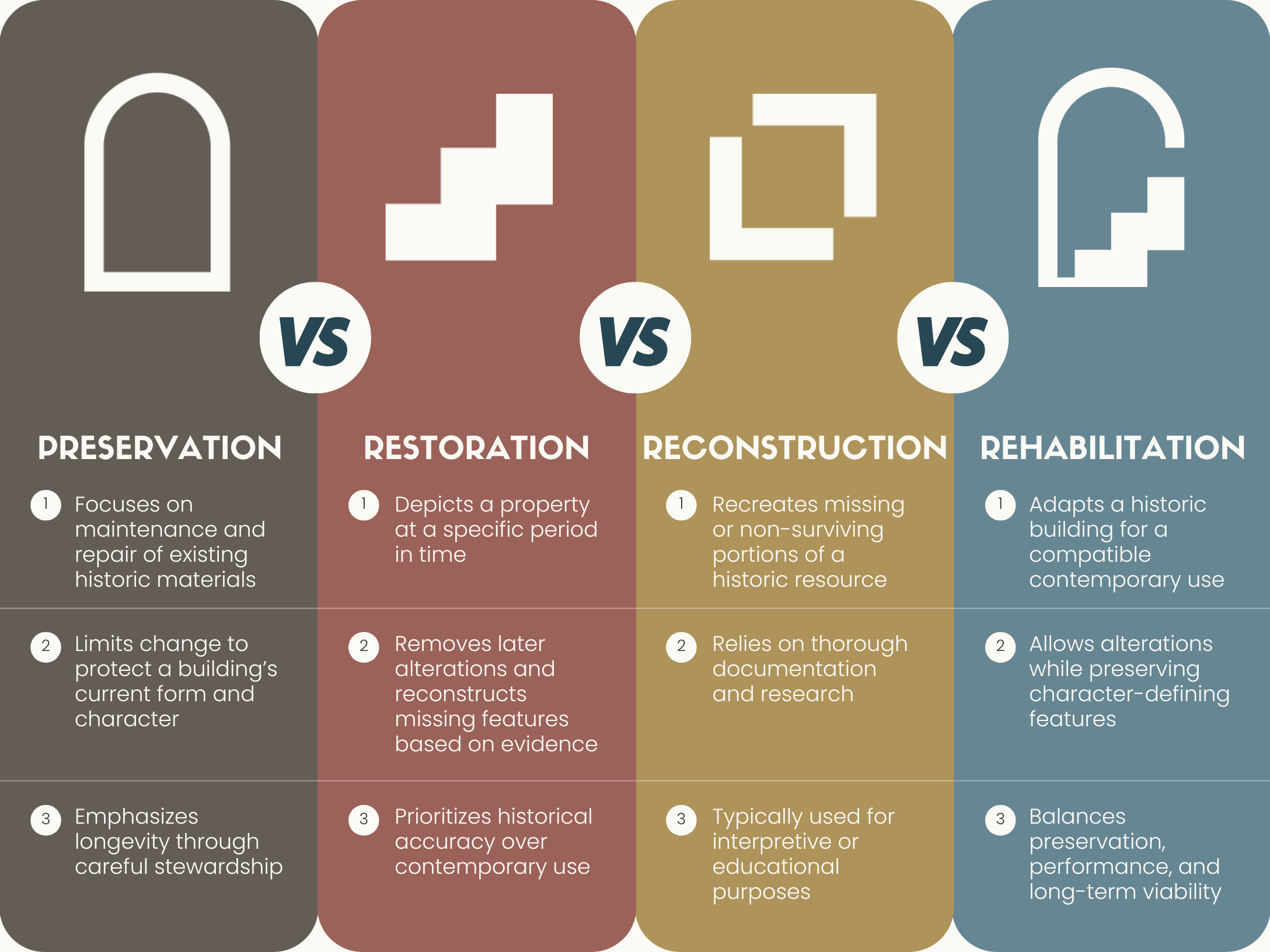
U.S. Secretary of the Interior Historic Preservation Treatment Types
The four treatment types
(but FYI: most projects are Rehabilitation)
One reason preservation gets misunderstood is because people use terms like “preservation” and “restoration” as a catch-all for distinct approaches. The National Park Service recognizes four treatment approaches, each with a different intent. (National Park Service)
Preservation: maintain and repair existing historic materials and features, with minimal change.
Restoration: depict a property at a specific time period, often removing later changes and reconstructing missing features based on evidence.
Reconstruction: recreate non-surviving portions of a property for interpretive purposes, using solid documentation.
Rehabilitation: make possible a compatible use through repair, alterations, and additions while preserving the features that convey historical, cultural, or architectural value.
Rehabilitation is the lane where most projects live. Buildings need modern life safety, accessibility upgrades, operational changes, and long-term performance. Rehabilitation assumes change will happen. The question is whether that change is compatible, legible, and respectful of what makes the building historic in the first place.
RWDC works exclusively on rehabilitation, which is often called Adaptive Use, or simply, Reuse. That is not accidental. It reflects the reality of working with owners, developers, and communities who need these buildings to serve a purpose, not just survive as an homage to history.
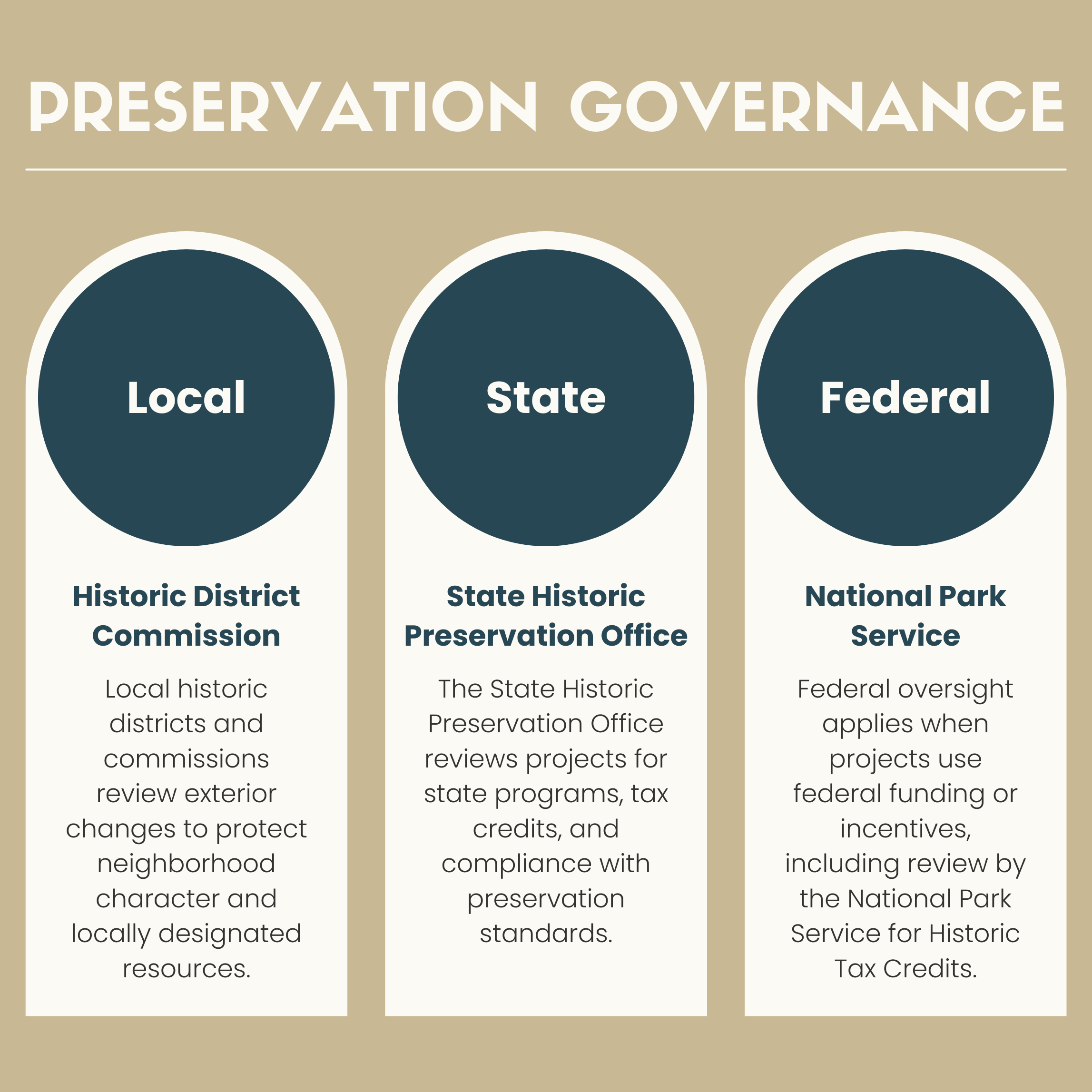
how preservation is governed
Local, state, and federal Levels
Preservation is layered.
The Secretary of the Interior’s Standards for Rehabilitation
The rules of the road
If you have ever heard “the Standards” referenced like an ominous rulebook, here is the practical truth: the Standards are simply a shared decision framework used to evaluate whether rehabilitation work protects historic character while allowing change. They are not prescriptive, meaning reviewers interpret these standards and their associated guides and documentation. They are regulatory for the Historic Preservation Tax Incentives program and commonly used by local commissions. The National Park Service is clear that the Standards encompass both the exterior and interior of historic buildings, and also cover related site features and related new construction.
A simplified way to understand the Standards is to group them into four decision clusters:
Use and character
Repair over replace
New work and additions
Materials and craftsmanship
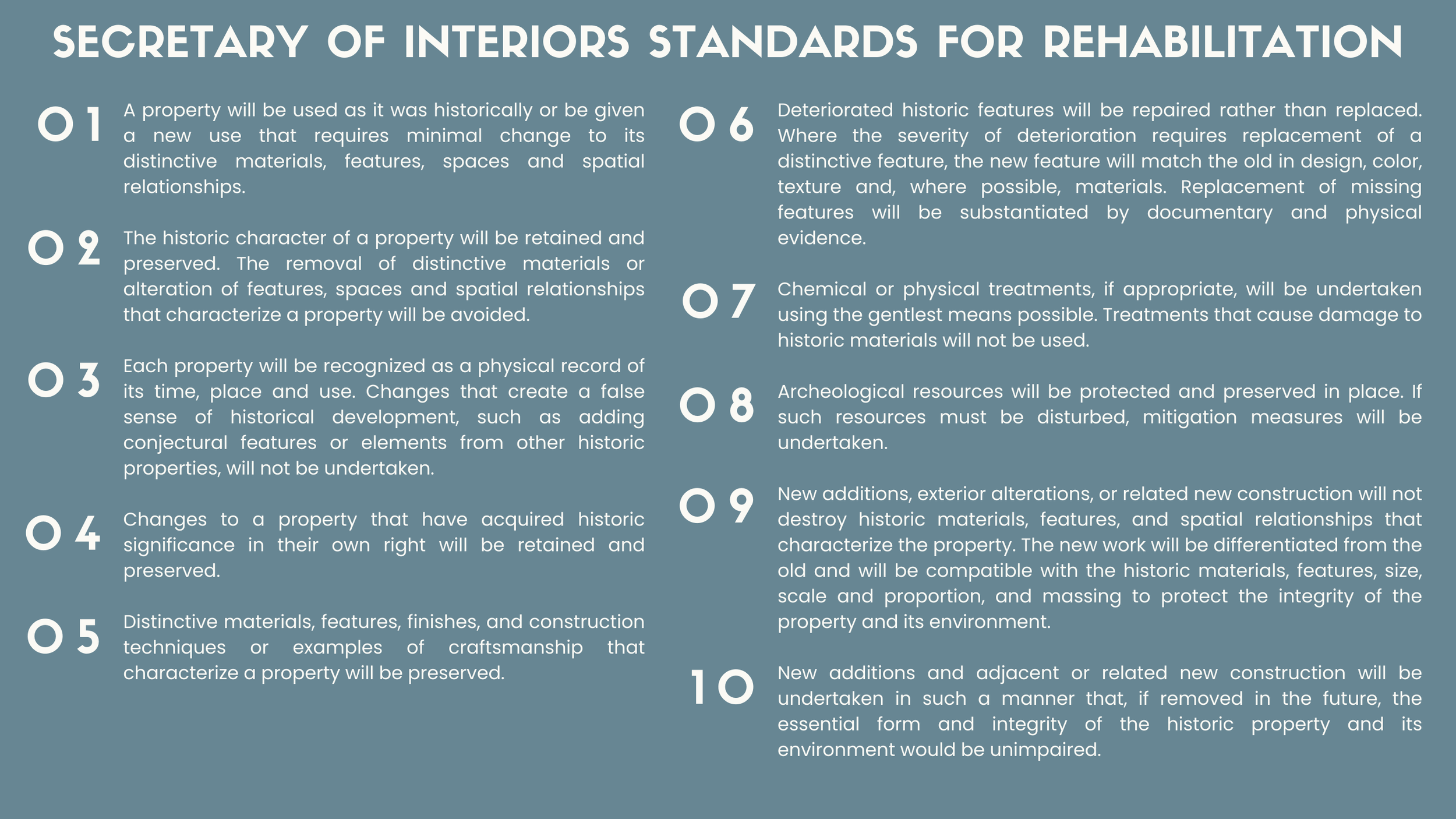
Courtesy of the National Park Service
Standards in practice: a non-technical decision playbook
Rehabilitation is a thousand decisions. Here are common categories that can become deal-breakers for approvals and tax credits. The goal is clarity, not fear.
Windows
Prefer repair-first logic and document conditions.
If replacement is necessary, match profiles and proportions, and avoid changing opening sizes.
Masonry
Use gentle cleaning methods and compatible mortar.
Avoid abrasive cleaning and hard mortars that can damage historic masonry.
Storefronts and entrances
Protect historic proportions and transparency.
Plan accessibility upgrades early so solutions feel integrated, not bolted on.
Additions
Keep additions compatible in scale and massing, while distinguishable from the historic building.
Interiors
Identify character-defining spaces and circulation early.
Avoid gutting significant interiors without evaluation and documentation.
Storytelling and historic buildings
If preservation is a framework, story is the glue that helps people understand why it matters.
Historic structures, banks, libraries, mills, Main Street storefronts, industrial buildings, early civic architecture, are repositories of our human story. They hold memory of industries, communities, and cultural shifts that shaped a place. Designing these spaces requires stewardship, not just selection.
Adaptive reuse as storytelling: the building is a co-author
In a good rehabilitation, the building becomes a co-author. Structural rhythm, patina, craft, and material logic inform what comes next: light, circulation, and the tactile experience of the space. When we treat an old building as a blank box, we lose the very thing the community and the market care about.
Preservation as emotional design
Research on place attachment describes a bond between people and places that shows up emotionally and behaviorally. In plain language: people do not just use places, they identify with them. That is why preservation projects are so visible, and why communities react strongly when beloved details disappear.
Community as the keeper of story
On paper, a building has drawings and archives. In real life, a building has lived experience: oral histories, routines, and memory. A project gains durability when we listen to the stories people tell and translate them into design decisions.
Why story matters for funding and approvals
Narrative is not just marketing. In preservation work, it becomes part of the process. Tax credit applications, for example, require clear descriptions of existing conditions, significance, and proposed work, backed by documentation.
Historic preservation tax credits
feasibility tools, not paperwork
Tax credits are not the right fit for every project. But when they are, they can have incredible impact and change feasibility.
Federal Historic Preservation Tax Credit
The federal program offers a 20% rehabilitation tax credit for qualified rehabilitation expenditures on certified historic structures, but it is limited to income-producing properties. Owner-occupied residences do not qualify for the federal rehabilitation tax credit. (National Park Service)
The federal application follows a three-part process, coordinated through the National Park Service:
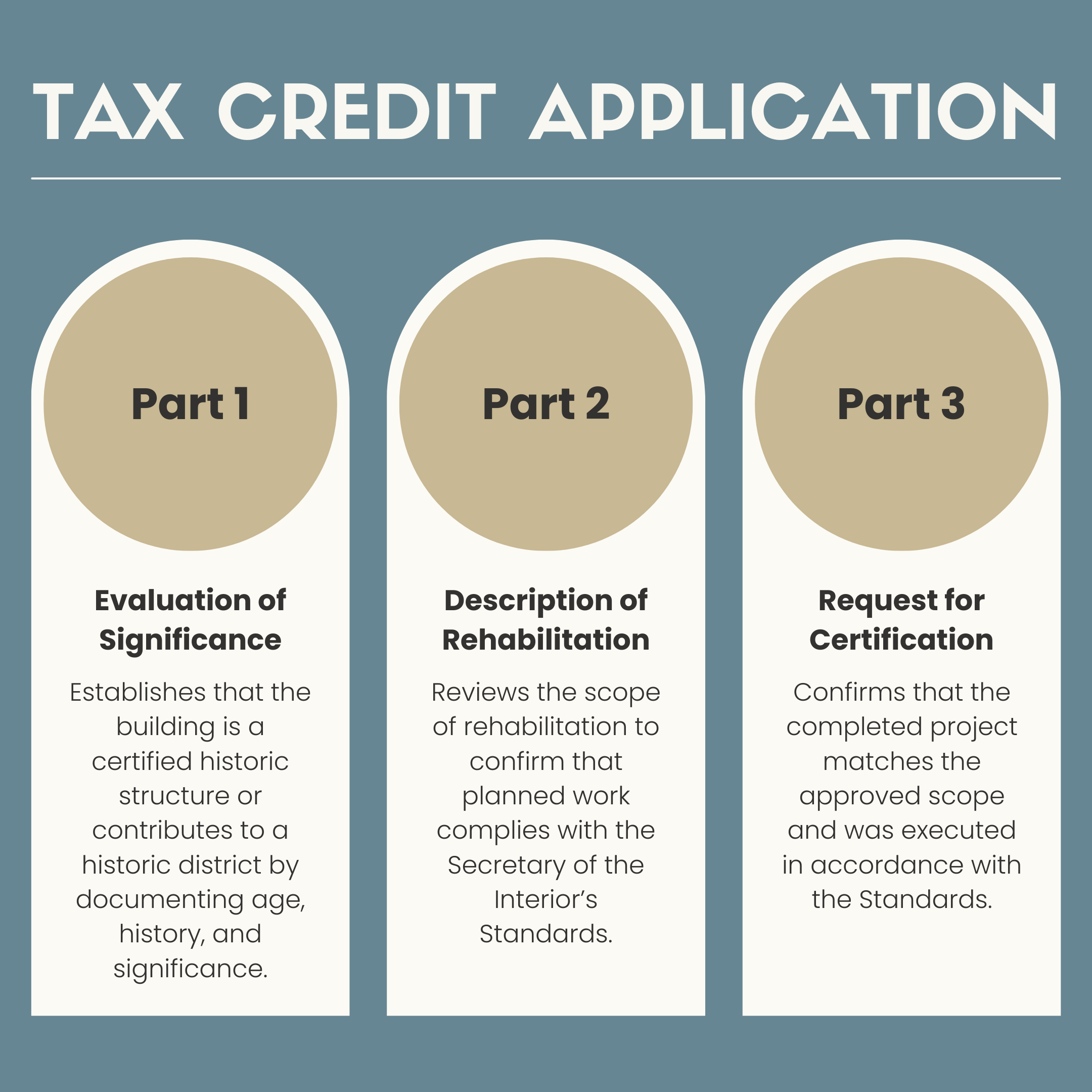
There are review fees associated, paid directly to the National Park Service. Often, developers and owners work with a preservation consultant to ensure a smooth process. Approvals can be delayed if there is missing information or if the design approach is incompatible with the Standards. The key takeaway: if you want the credit, you plan for compliance early. You do not “add it on later.”
Michigan State Historic Preservation Tax Credit
Michigan’s 25% state historic tax credit program uses a similar, but distinct three-part application process and operates with an annual program cap allocated across categories (owner-occupied/residential, small commercial, large commercial). Program availability and category allocations can shift year to year, and timing matters. The current version of the state credit has significant financial caps, and thus, is currently closed for small and large commercial projects. However, the state credit is available for owner-occupied buildings, and residential applications are still being accepted. See their website for current updates: MEDC
If your project is commercial or mixed-use, this is exactly why early feasibility work matters. Incentive availability can shape timing, financing, and scope decisions.
There is active legislation aiming to increase the annual cap to $100, which would have a significant impact on economic development and community revitalization in communities across Michigan. Consider sharing your support for H.B. 4503 and H.B. 4504.
Documentation is not optional
Tax credits are documentation-heavy because they are compliance programs. NPS requires photos keyed to plans and the application narrative, along with drawings and clear descriptions of proposed work.
Beyond tax credits
complementary Michigan funding pathways
Many Michigan rehabilitation projects rely on layered funding and incentives, often stacked in a way that is community-specific. Depending on the project type and location, you may encounter:
CLG grants for planning, documentation, education, and some development work in qualifying communities
Brownfield which can reimburse eligible costs tied to redeveloping blighted or functionally obsolete properties under approved plans
Downtown Development Authority DDA and corridor tools, including local TIF authorities, facade programs, and district investments that support public infrastructure and place-making
Housing tools (where applicable) for income-producing residential reuse
The key is not chasing every possible program. It is aligning the building, the intended use, and the community goals with the right path, then sequencing work to match.
Sustainability and embodied carbon
reuse as climate action
Carl Elefante famously said, “the greenest building is the one already built”.
New construction carries upfront emissions tied to material extraction, manufacturing, transportation, and assembly, often called embodied carbon.
AIA and the National Trust note that reuse and retrofit avoids embodied carbon emissions, and they cite research showing building reuse can avoid roughly 50 to 75% of the embodied carbon emissions an identical new building would generate.
National Trust reuse research has also been widely cited for the finding that it can take 10 to 80 years for a new, efficient building to “pay back” the carbon debt of demolition and replacement through operational savings.
Practical low-carbon rehab moves include:
retain structure and envelope where feasible
design for material efficiency and selective demolition
prioritize salvage, reuse, and deconstruction where components cannot be retained
Rehabilitation is cultural stewardship and climate strategy. The early scope phase is where climate, cost, and character can align, or conflict.
“Do I qualify?”
A simple eligibility reality check
Before you budget credits into a pro forma, get clear on these questions:
Is the property historic, or potentially eligible?
Is the property income-producing (required for federal only)?
Is your scope actually rehabilitation, not demolition and rebuild?
Can the work meet the Standards for Rehabilitation?
Can you document existing conditions and proposed changes clearly?
Do you know which review bodies are involved? (local, state, federal)
If any of those are unclear, the next step is not design. The next step is clarification.
Accessibility and life safety
belonging within constraints
Historic buildings were not designed for modern accessibility and life safety expectations, but the goal is not to choose between preservation, belonging, and safety. The work is to do both.
NPS guidance on accessibility emphasizes:
identifying character-defining features,
assessing barriers and requirements, and
evaluating accessibility options that provide access with the least harm to historic character.
In practice, this often looks like carefully located ramps and lifts, hardware and door strategies that improve access without removing historic fabric, and early coordination so egress and fire protection solutions are integrated into the design, not tacked on at the end.
The preservation team
who does what (and why clarity matters)
Preservation succeeds when roles are clear and communication is consistent.
Owners and developers: define the vision, risk tolerance, operating plan, and financing strategy.
Architect and Interior Designer: translate and document the vision into a scope and design that can meet codes, and budgets
Contractor: support constructability, sequencing, pricing, and surfacing unknown conditions.
Preservation Consultant: support preservation compliance and develop tax credit application.
Michigan SHPO and federal reviewers (as applicable): evaluate significance and compliance for program participation and certification.
Local historic district commission (as applicable): review exterior changes in locally designated districts.
Tax credit consultants and financing partners: structure timelines and compliance for larger deals.
Community and users: contribute lived experience and long-term stewardship, shaping what the building should become.
Reed Walker Design Collective: We serve as both Interior Designer and Preservation Consultant. We oversee preservation coordination, design adherence to the Standards, coordinate tax credit submission on behalf of the applicant/owner, identify risks as design and construction proceed, provide bespoke interior design that builds on the story and character of the building, community, and client.
We function as translators and integrators. We help teams make early decisions that align story, scope, Standards, codes, and incentives. We document what needs to be documented and keep the work grounded in both the practical and the meaningful.
If you are considering a historic building in Michigan, start before the scope is locked. Preservation planning is not the slow part of the project. It is the part that makes the rest of the project possible.
a practical checklist For building owners
start here
If you have a historic building (or are considering buying one), start with clarity:
Confirm designation status
Decide the intended use
Document existing conditions early
Choose the right treatment approach intentionally
Map approvals and incentive pathways
Assemble the right team early
Preservation planning is not administrative overhead. It is how you protect value, reduce risk, and make better decisions from day one.
If you are considering rehabilitation, tax credits, or a Main Street reinvestment and want a clear, Standards-informed path forward, we can help you define scope, align stakeholders, and set your project up for approval and long-term relevance.
Ready to get started? Ready to talk through your building’s next chapter? An Onsite Insight or discovery call is often the best first step.
