
insight: every space tells a story
Why Narrative is the Foundation of Meaningful Interior Design
Design is never just about what we see. It’s about what we feel, what we remember, and how we connect. Design is about legacy, community, and the quiet human moments that unfold in a space long after the design team and contractors leave. At the center of it all, especially in historic buildings, adaptive use projects, and the civic, hospitality, and Main Street spaces that shape our communities, is one essential piece.
Story.
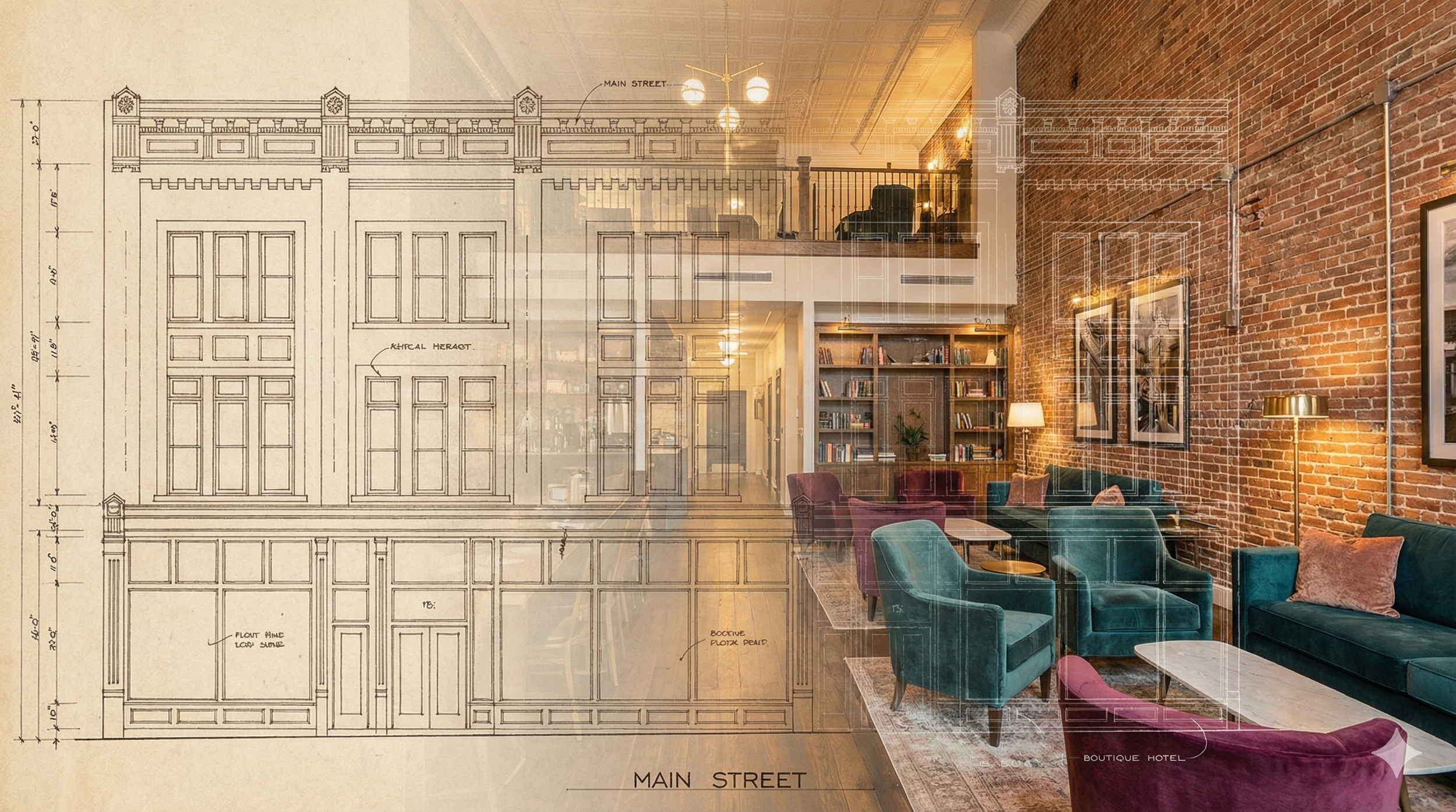
A Historic Main Street blueprint overlaid with a conceptual rendering of a reimagined community space. Generated by AI.
At Reed Walker Design Collective, storytelling isn’t marketing language written after a space it built. It is the structural framework that guides how we design, collaborate, and bring spaces to life. Without narrative, the WHY and the WHO, even the most beautiful spaces can feel hollow. Well styled, but void of meaning. With narrative, they become about more than the WHERE and WHAT, and become places that people care about.
This month, we want to explore why storytelling matters deeply in interior design and community development, particularly for historic buildings and adaptive use projects in our downtowns; how we build narrative with our clients through our Collective Co-Design Process; and why working without story often leads to projects that struggle.
We hope you will join us, and stick around for a link to sign up for the upcoming Winter Edition of our Insight Newsletter where we will share year-end reflections, project milestones, and strategies for the year ahead.
WHY STORYTELLING MATTERS IN INTERIOR DESIGN
Humans are wired to understand the world through story. It is innate to our biology. Research across psychology, design, and environmental behavior shows that we don’t just use spaces, we interpret them. We make meaning of the sensory input we derive from the experience. We internalize cues about safety, belonging, orientation, identity, memory, and behavior. These cues influence how we move, how long we stay, and how we feel while we are there.
Designers who understand story have a powerful advantage: they can intentionally shape experiences rather than just solving for a programmatic checklist. We can use design to mitigate unwanted behaviors or encourage what we do want. We aren’t just pulling together random furniture, finishes, and lighting. We set the stage and create specific spaces to support the human behaviors and interactions that a space should foster.
Narrative Makes Spaces Coherent, Legible, and Meaningful
In a world where we are bombarded with ever more information, the study of environmental behavior has highlighted how appropriate curation of elements can make a space feel right, often subconsciously. Kaplan and Kaplan’s framework helps clarify the emotional, cognitive, and physical experience of space through:
Coherence - spaces make sense
Legibility - understanding where you are and how to navigate and interact within it
Complexity - richness and intrigue add to the human experience
Mystery - the invitation for exploration enriches how we interact with space
These are not stylistic ideas, they are fundamental to how humans perceive and navigate our environments. When a designer uses story to guide decisions, coherence and legibility emerge naturally because all elements, from lighting to materials to furniture to flow, align around a clear narrative.
Narrative Creates Emotional Connection
Symbols, color, texture, spatial rhythm, lighting levels and patterns, and form all carry meaning. It varies by community and culture, but research on iconography and emotional design shows that we form subconscious connections to sensory cues. These associations, whether color association, material patina, light temperature, sound, and even spatial proportions form the basis of our experience in a space. While human interaction, service, aroma, the quality of the food and other such elements are imperative, the setting establishes our first and lasting impression. When we root this in story, design becomes more human and more memorable.
Narrative is Especially Powerful in Historic Buildings
History buildings come with their own built-in narrative assets:
layers of past uses
original material, craftsmanship, and architectural details
stories from the communities
culture and economic legacy
physical character shaped by time, use, and users
In adaptive use and preservation work, story becomes not just the design driver, but a stewardship responsibility. The community often feels deep attachment to its buildings. These space hold identity, pride, memories, generational ties, and sometimes trauma. Grounding the narrative honors that history while making room for the building’s next chapter.
Here in Michigan, where rural and urban communities alike are investing in their historic downtown cores, story is essential to making design authentic and developing a sense of place versus generic, cookie-cutter replication of the box store chains that make so many places feel like just another set of buildings that could exist anywhere in the country.
THE PILLARS OF NARRATIVE-DRIVEN DESIGN
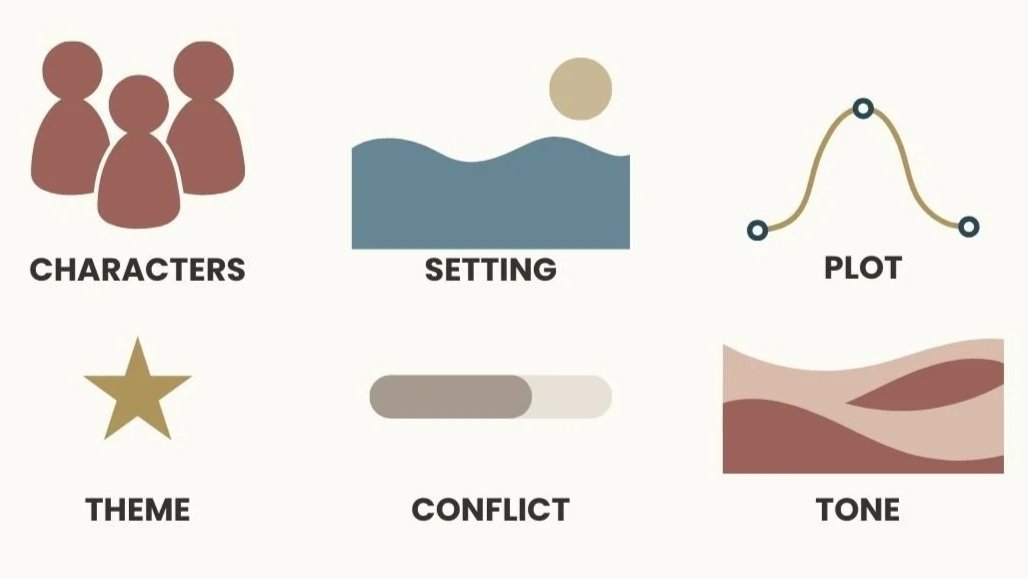
The Pillars of Narrative-Driven Design, as utilized by Reed Walker Design Collective
Modern research, from branding, architecture, writing, film, and human-centered design, shows that successful narratives are built on foundational elements. These elements vary, but consistently include: Characters, Setting, Plot, Theme, Conflict and Tone. We use these pillars in every RWDC project.
Character: who the space serves
The people who use a space are the characters in its story. In a community-centered project, these characters have diverse backgrounds, ages, sensory needs, and expectations.
In our work, identifying the characters includes:
Residents and community members
Patrons, visitors, and guests
Multigenerational family members
Staff and service providers
Owners and investor
When we understand the characters, their priorities become design criteria, shaping seating options, circulation paths, acoustic strategies, sensory zoning, wayfinding systems and more.
2. Setting: where and when
Some of you might think the space itself is the setting. Yet, the setting expands far beyond the physical volume of space. We must understand where and when we exist within the context of the building and community in order to establish how the space will serve a purpose for this next chapter.
For example:
For our midcentury modern library in Bloomfield Township, the story includes its relationship to Cranbrook’s design lineage, the early 2000s renovations specific to the technologies of that era, and the changing needs and expectations the current patrons expect of a modern community resource.
For a historic bank converted into a boutique hotel, the story includes material honesty, local craft, small-town industry, and architectural restraint.
In a downtown storefront retail flagship, the story includes the rise and decline of Main Street commerce, cultural shifts, and community resilience.
In a Lakefront home renovation, the shifting dynamics as children reach adulthood and return with their young families fundamentally changes how this home serves the owners now and into the future
A space’s setting does not constrain creativity; it focuses it.
3. Plot: the overall sequence and experience
This is where sensory intelligence becomes essential. The plot guides us, often straightforward and legible, while providing a few surprises and delights along the way. These elements translate narrative into experience and includes:
Color (emotional resonance, luminosity, saturation)
Light (circadian rhythm, visual comfort, transition)
Texture and materiality (acoustics, temperature, durability)
Sound (auditory comfort, activation vs. calm)
Smell (memory, brand identity, environmental cues)
Spatial geometry (proportion, rhythm, framing)
The plot provides the context and experience.
4. Theme: the project’s guiding idea
Theme is the distilled purpose or mission of the project. It is the “North Star” that directs every decision. It captures what the space should mean for people.
Themes might include:
Belonging
Stewardship
Craft and community
Heritage and innovation
Resilience and regeneration
Calm and introspection
When we define theme early, we prevent design drift and maintain alignment among owners, partners, and consultants.
5. Conflict: Competing Interests and Constraints
Conflict is the tension that shapes a project’s direction. It isn’t about discord, it’s about acknowledging the push-and-pull of real-world conditions and using them to strengthen the narrative. Every design project contains multiple layers of competing interests, expectations, and constraints. These points of friction become the clues that guide us toward clarity.
In narrative-driven design, we look closely at the intersections between:
Characters: What patrons need vs. what staff require; what community members envision vs. what owners will invest in, how a family uses their home on a given Tuesday evening vs hosting a large holiday party.
Place: What the building wants to be (architecturally, historically, structurally) or is required to be when Historic Tax Credits are being utilized vs. what the program demands today.
Resources: Time, budget, construction realities, code requirements, and long-term maintenance.
For RWDC, conflict helps reveal what the space must resolve. Conflict becomes the engine of the design narrative. By naming the tension, whether aesthetic, functional, financial, or cultural, we can intentionally design solutions that transform these constraints into opportunities for clarity, innovation, and cohesion.
6. Tone: How the Space Should Feel
Tone is the emotional undercurrent of the project. It is the feeling you want someone to sense the moment they cross the threshold. While the theme defines what the space means, tone expresses how it should feel while you’re in it. It’s the mood that ties together every material choice, lighting decision, and spatial gesture.
In narrative-driven design, tone is shaped through:
Atmosphere: soft vs. bright lighting, warm vs. cool palettes, stillness vs. movement
Materiality: natural textures vs. refined finishes; high contrast vs. low contrast
Pacing: the choreography of moments: quiet nooks, active zones, transitional spaces
Behavior cues: how the space invites people to gather, explore, linger, or focus
Examples of tonal direction might include:
Welcoming and grounded: a library that feels like an anchor in the community, warm woods, natural light, approachable scale.
Refined but familiar: a boutique hotel that balances luxury with small-town authenticity, and tailored details paired with textural comfort.
Energetic and expressive: a youth-centered makerspace that signals creativity through color blocking, tactile surfaces, and dynamic lighting.
Calm and restorative: a wellness environment that reduces sensory overload by integrating a muted palette, diffused light, and generous negative space.
Tone is not decorative; it is strategic. When aligned with character, setting, plot, theme, and conflict, tone becomes the emotional signature of the project. It ensures that the story isn’t just understood—it’s felt.
Why Projects Without Story Struggle
We are occasionally brought into a project after construction has begun or as a consultant to a general contractor or architect, well after the conceptual phase has passed.
These projects often have:
no clear direction
multiple competing visions
a patchwork of aesthetic ideas
misalignment between owner and design team
decisions made under pressure, not intention
space that feels generic or overly trendy
little emotional resonance
Infinite options without narrative lead to paralysis and inconsistency. Without story, you rely on preference instead of purpose, and preference alone cannot produce meaningful, durable interiors.
When story is missing, clients often feel it first.
And when story is present, everyone feels it.
Our Process: how rwdc builds story
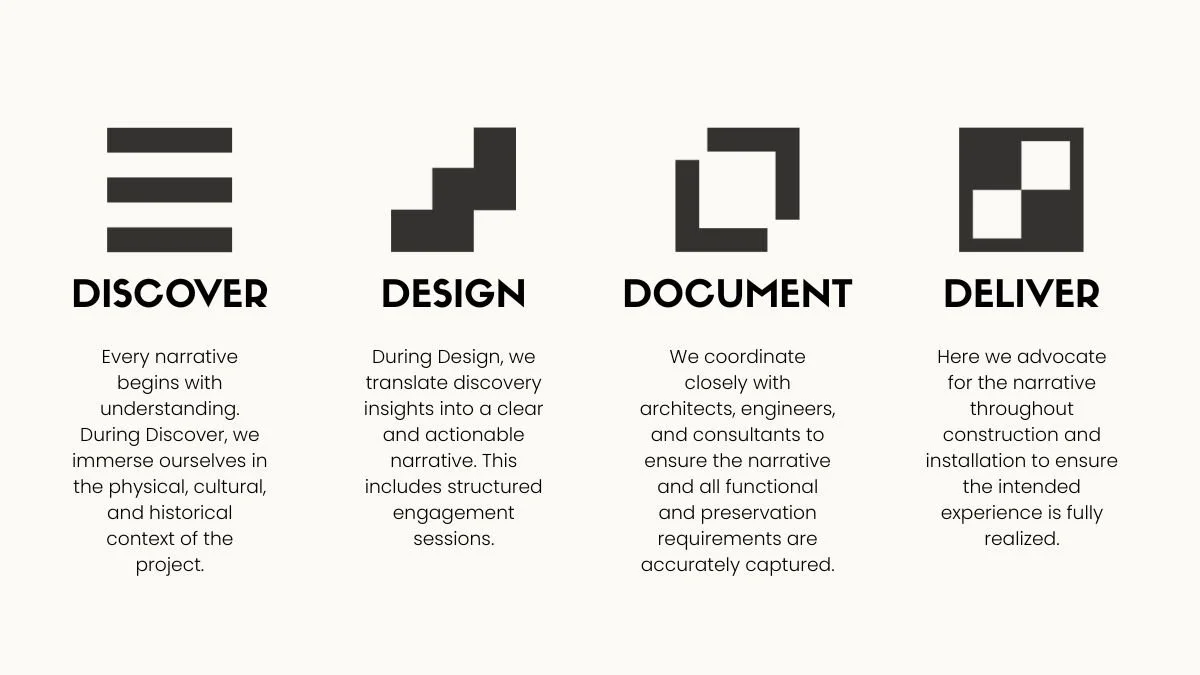
Narrative-Based Design as integrated into Reed Walker Design Collective’s Collective Co-Design Process
Storytelling is the foundation of our Collective Co-Design Process. Rooted in research, preservation expertise, community engagement, and nearly 25 years of practice, narrative becomes the throughline that guides every phase of our process.
DISCOVER — Listening, Research, and Alignment
Every narrative begins with understanding. During Discover, we immerse ourselves in the physical, cultural, and historical context of the project. This includes:
Site visits, walking audits, and environmental quality observations
Stakeholder interviews across age groups, staff roles, and user types
Archival research, historic analyses, and assessment of preservation eligibility
Behavioral observations and patterns of use
Understanding constraints, opportunities, budgets, and economic goals
For historic properties, this phase also includes analyzing periods of significance, alignment with the Secretary of the Interior’s Standards, and identifying potential federal or state tax credit pathways.
Within this phase, we identify important elements, including:
Characters (users, stakeholders, audiences)
Setting (place, history, context, timing)
Theme (the project’s guiding idea)
The Discover phase culminates in a foundational understanding, your space’s story, needs, and future direction.
DESIGN — Shaping the Vision Through Narrative
During Design, we translate discovery insights into a clear and actionable narrative. This includes structured engagement sessions such as:
Visioning workshops
Furniture testing and full-scale mockups
Conceptual mood sessions
Community coffee chats and listening sessions
Targeted surveys
Deep-dive discussions about identity, culture, and mission
One of our most revealing prompts is: “What does this place mean to you?”
It uncovers memory, identity, sentiment, and the emotional drivers that shape the design.
From this work, we synthesize a narrative document built around:
Characters (users, stakeholders, audiences)
Setting (place, history, context, timing)
Theme (the project’s guiding idea)
Plot (the sequence and sensory experience of the space)
Conflict (constraints, tensions, needs)
Tone (the desired emotional quality of the environment)
This narrative becomes the compass for all design decisions, helping reduce ambiguity and align multidisciplinary partners throughout long, complex projects.
Next, we express the narrative spatially—refining layouts, flows, and sensory thresholds; choreographing lighting; selecting materials with meaning and longevity; and defining how the space will feel, function, and evolve.
Outcome: A cohesive, narrative-driven design ready for documentation and execution.
DOCUMENT — Translating Story into Detailed Construction Information
Document is where the story becomes buildable. We coordinate closely with architects, engineers, and consultants to ensure the narrative—and all functional and preservation requirements—are accurately captured.
This phase includes:
Full construction documentation packages
Interior elevations, details, and millwork design
Finish schedules, lighting plans, hardware, plumbing, and FF&E documents
Preservation-specific detailing for historic projects
Review of all materials for compliance with Standards for Rehabilitation when applicable
We also support bidding and negotiation by reviewing contractor proposals and ensuring alignment with the design intent before construction begins.
Outcome: A coordinated, comprehensive documentation set aligned with story, standards, and scope.
DELIVER — Bringing the Story to Life
During Deliver, we advocate for the narrative throughout construction and installation to ensure the intended experience is fully realized.
Our role includes:
Construction Administration and site observation
Reviewing submittals for adherence to design intent
Responding to design-related questions
Supporting contractors and trades with clarifications
Ensuring every detail—from millwork to lighting—is implemented with accuracy
When clients select our Procurement Services, we also provide:
FF&E sourcing, bidding, purchasing, tracking, and delivery
Artwork, accessories, and signage coordination
Installation oversight, ensuring the final layers of the story are placed with care
Outcome: A fully realized environment—crafted with intention, grounded in story, and delivered with confidence.
How to Start a Story-Driven Design Project
If you’re planning a new build, renovation, adaptive reuse, or historic rehabilitation in Michigan, or anywhere, here are questions worth exploring:
What is the story of this building or place?
How has it changed over time?
Who will use this space in the future and what do they value?
What emotional qualities should the space evoke?
What parts of the building’s identity must remain intact?
What community or cultural references should be honored?
What emotional qualities should the space evoke?
How can design support belonging for all users?
How can story guide investment, materials, and priorities?
Consider economic tools (tax credits, incentives) early as this may drive narrative through historic requirements
You don’t need answers yet. You just need curiosity. Story will emerge.
Conclusion: Story is Design Strategy
A narrative is not "extra." It’s the framework that keeps a project cohesive, contextual, and connected to its community. It is strategy, not decoration. It bridges past and future, connects people to place, and turns buildings into communities.
Whether we’re designing a library, a boutique hotel, a historic Main Street storefront, or a private residence, our work begins with listening deeply and telling the story of a place with integrity and care.
Ready to Discover the Story of Your Space?
If you’re planning a project in 2026—whether interior design, historic preservation, or adaptive reuse—we’d love to learn what you’re envisioning.
Start here by filling out our Project Inquiry Form
Want More Insights?
Our Winter Edition of the Insight Newsletter arrives soon, featuring:
year end reflections
design insights for the season ahead
behind the scenes on our projects
upcoming speaking events
Sign up HERE
Here’s to designing with meaning, memory, and story.
Be well,
Jenna
