
insight: downtown revitalization in michigan
Design as a Cornerstone of Economic Vitality
Many historic downtowns are architecturally intact but economically fragile.
The brick and cornices remain. The storefront rhythm persists. The sidewalks still trace the historic grid.
Yet upper floors sit vacant. Buildings are underutilized. Regulatory complexity and financing gaps stall reinvestment before it begins.
At the same time, we are operating in a digital-first economy. Work happens on screens. Retail is frictionless. Convenience has been optimized.
Downtowns cannot out-Amazon Amazon. They must out-experience it.
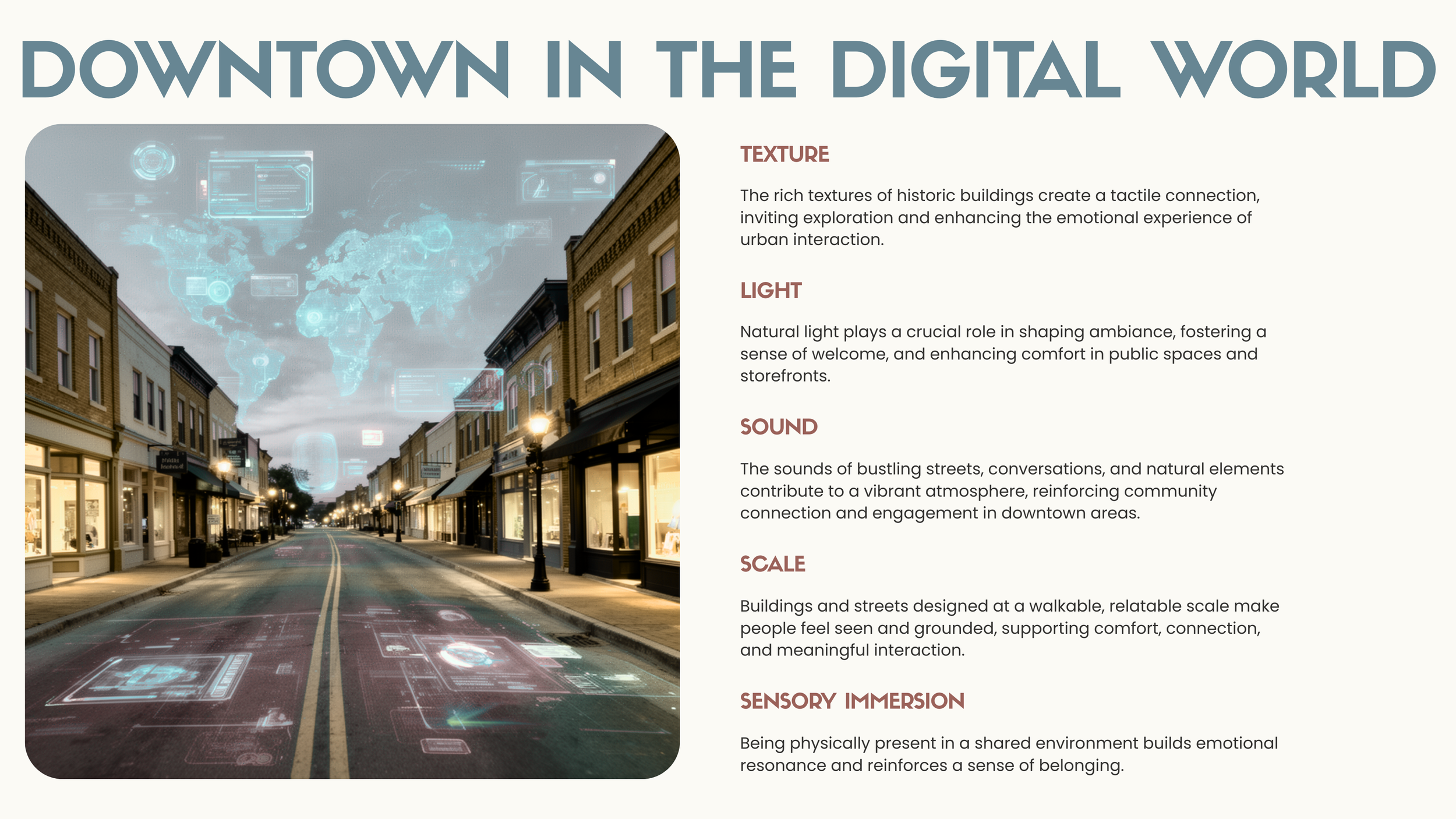
Historic downtowns offer something digital space cannot replicate: texture, natural light, sound, human scale, and sensory immersion. These qualities foster presence. They shape memory. They create emotional attachment.
That emotional layer is not separate from economic vitality. It is foundational to it.
Design is not decoration. It is a cornerstone of economic vitality.
Thoughtful interior and exterior design increase dwell time, strengthen tenant stability, improve occupancy rates, support property values, and expand long-term municipal tax base. Preservation-based economic development is not a marketing slogan. It is the foundation of the Main Street model.
If downtown revitalization is the goal, design must be treated as infrastructure.
The Economics of Experience
Environment shapes behavior. Behavior drives revenue.
In today’s experience economy, discretionary dollars are increasingly directed toward places that offer novelty, participation, and belonging rather than simple transactions. People seek authenticity over generic development. Walkability over convenience. Immersion over efficiency.
Research in environmental psychology and behavioral economics reinforces what many Main Street leaders intuitively know: physical context influences purchasing behavior, loyalty, and return visits.
Lighting and acoustics affect comfort.
Layout influences circulation.
Transparency signals welcome.
Material authenticity communicates quality and place.
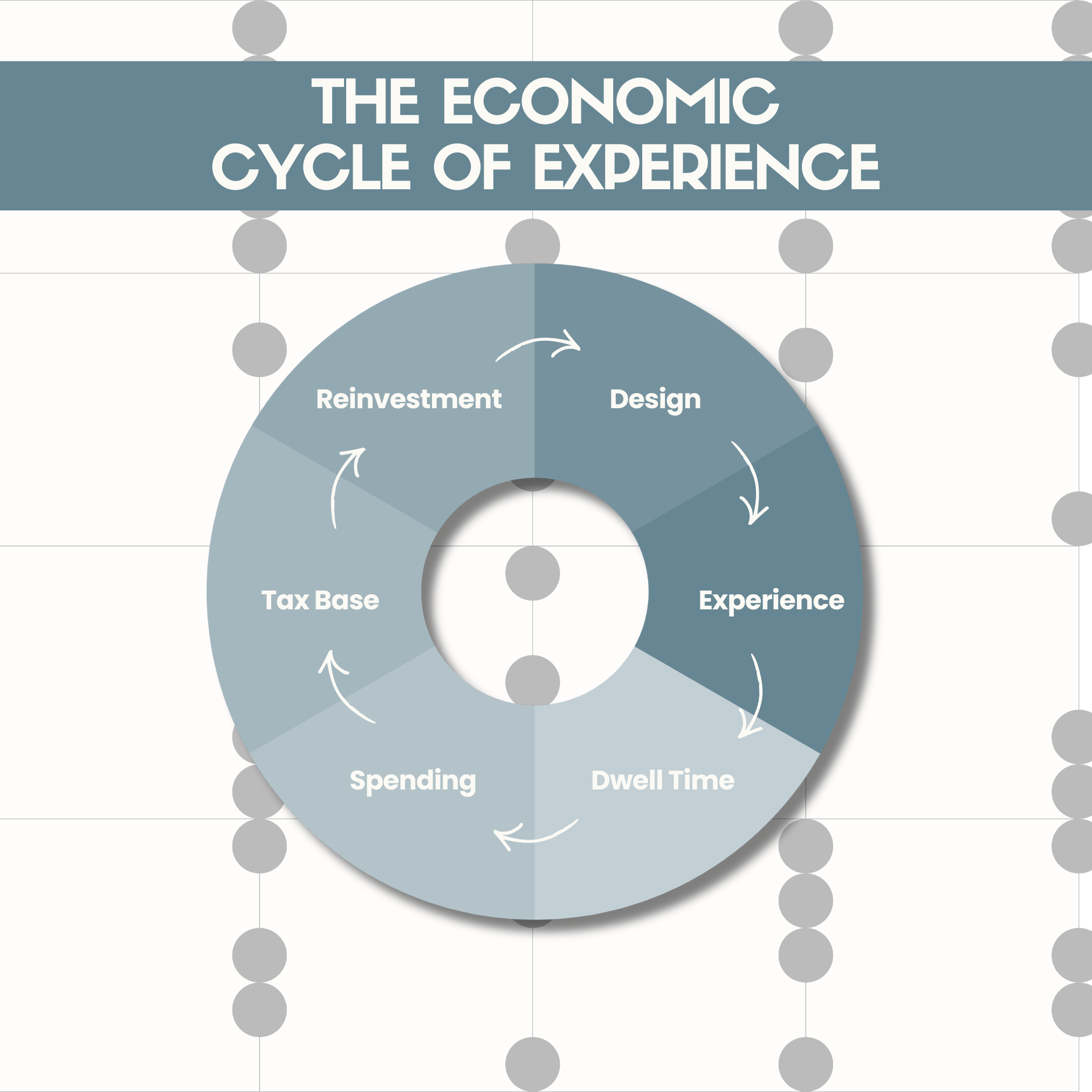
When dwell time increases, three things follow:
Sales increase
Return visits increase
Word-of-mouth increases
This relationship can be understood simply:
Facade grants alone do not drive economic vitality. What happens inside the building determines:
Sales per square foot
Lease rates
Business survivability
Upper-floor occupancy
Visitor retention
Experience is revenue.
Design Within Downtowns
Design begins at the sidewalk.
It continues through the front door.
Within the Main Street framework, Design is one of four coordinated pillars alongside Economic Vitality, Promotion, and Organization. It is not separate from any of these, but rather, it enables and enhances them.

Small decisions compound into atmosphere. Atmosphere drives behavior. Behavior drives economic impact.
A downtown may be picturesque, but without welcoming interiors, comfortable gathering spaces, clear entry sequences, and sensory richness, visitor experience plateaus. Cohesive storefront strategies, warm lighting, acoustic moderation, and visible activity create psychological signals that a district is thriving.
Exterior signals vitality.
Interior sustains it.
Authenticity as Competitive Advantage
Historic buildings carry embedded narrative and embodied energy. They reflect craft, identity, and community memory.
Before tax base, there is emotional capital.
Communities invest in places that feel meaningful. Economic capital follows that emotional attachment.
Historic preservation research consistently identifies economic impact categories tied to rehabilitation:
Rehabilitation is labor-intensive. More dollars remain local through skilled trades and professional services. Historic districts consistently demonstrate stronger property value performance than comparable non-designated areas. Authentic environments attract heritage tourism, drawing visitors who spend on lodging, food and beverage, retail, and cultural experiences.
Authenticity is not nostalgic. It is differentiation in a landscape saturated with generic development.
Your downtown will not compete with a highway corridor on speed or parking volume. It can compete on meaning.
Preservation Standards and Interior Performance: Alignment, Not Opposition
Preservation compliance is often framed as a barrier. In reality, it is a framework that protects long-term value.
The Secretary of the Interior’s Standards influence more than facades. They apply to interior spatial volume, character-defining rooms, circulation patterns, historic staircases, columns, storefront configurations, decorative finishes, and significant architectural features.
Late-stage alterations that remove or radically alter these elements can jeopardize Historic Tax Credit eligibility, even if exterior work appears compliant.
Interior performance goals such as accessibility, mechanical integration, acoustics, energy efficiency, hospitality programming, and layout adjustments must align early with preservation strategy. When compliance and performance are integrated from day one, risk decreases and funding opportunities remain intact. When alignment happens late, redesign costs increase and financing becomes more uncertain.
Preservation compliance and modern comfort are not opposites. With strategic integration, they reinforce one another.
Incentives and Strategic Alignment in Michigan
Michigan communities have access to powerful tools that strengthen project feasibility:
Federal Historic Tax Credit (20% of qualified rehabilitation expenses)
State Historic Tax Credit programs (25% of qualified rehabilitation expenses) *when active: commercial at capacity for 2026
Brownfield redevelopment financing
DDA and TIF mechanisms
MEDC programs
Certified Local Government support
Grants and technical assistance
These tools require strategic alignment. Tax credits are not grants. They are performance-based incentives tied to compliance. Projects fail when preservation strategy, design intent, and funding pathways are disconnected. They succeed when scope, compliance, budget, and interior performance are integrated from day one.
Design clarifies feasibility. Aligned design becomes fundable.
Design’s Direct Economic Impact
Interior and exterior rehabilitation transforms underutilized buildings into productive economic engines.

Increased Dwell Time
Layered lighting, comfortable seating, acoustic strategy, intuitive layout, and sensory richness extend visits. In hospitality adaptive reuse, experiential layering drives occupancy rates and repeat bookings. In retail, comfort and clarity increase transaction likelihood.
Tenant Attraction and Retention
Well-designed shells attract stronger tenants. Efficient back-of-house planning, appropriate code integration, ergonomic layouts, and inviting customer environments support business stability. Lease rates correlate with build-out quality. Retention reduces vacancy churn.
Upper-Floor Activation
Underutilized upper floors represent unrealized tax base. Converting them to housing, hospitality, creative office, or studio space increases:
Rental income
Property valuation
24-hour activity
Perceived safety
Street vitality
Upper-floor rehabilitation is explicitly linked to economic resilience within the Main Street framework.
Property Valuation and Lending Confidence
Design-forward rehabilitation strengthens appraisal performance. Lenders assess risk through income projections and market viability. Interior design directly influences both. Interior rehabilitation is not a finishing layer. It is the performance engine.
Design Within the Main Street Framework
The Main Street model is structured around four coordinated pillars :
Economic Vitality
Design
Promotion
Organization
Design is not separate from economic vitality. It enables it.
Design supports:
Wayfinding clarity
Accessibility compliance
Streetscape cohesion
Brand identity
Upper-floor activation
Business incubation
Transformation requires cumulative, coordinated effort rather than isolated projects .
A strategic question for DDAs and Main Street boards:
What if design committee work included interior consultation alongside facade review?
Exterior signals vitality. Interior sustains it.
Accessibility and Belonging as Market Expansion
Inclusive design is economic strategy.
Flexible seating, universal design principles, sensory-aware zoning, and clear wayfinding expand who can comfortably participate in downtown environments. ADA improvements increase user base. Clear circulation reduces friction. Flexible layouts increase adaptability.
Belonging expands market reach.
In a digital-first era marked by isolation, physical gathering spaces matter. When more people feel comfortable, more people participate. Participation increases dwell time. Dwell time increases spending.
Belonging is economic infrastructure.
Measuring Impact
Design is not abstract, it must be measurable.
Communities can track:
Ground-floor occupancy rates
Upper-floor activation
Pedestrian counts
Private reinvestment totals
Vacancy reduction
Before-and-after photography paired with occupancy data strengthens funding applications. Pedestrian count analysis can demonstrate improvements in walkability. DDA vacancy tracking can reveal where investment correlates with stabilization. Data strengthens funding applications; story strengthens community trust, and together, they build momentum.
Accessing Design for Small Businesses
Design support does not have to be all or nothing.
Many small business owners assume design expertise requires major capital investment. Thoughtful design does not mean expensive finishes. It means clarity of layout, lighting balance, acoustic moderation, clear entry sequences, and operational efficiency. Early consultation reduces costly redesign. Incremental improvements compound. Strategic insight at the right moment can shift project trajectory without requiring full-scale construction.
Design can be phased. It can begin with clarity rather than construction. There are many consultants and small firms that may be a better fit for the scope and scale of Main Street programs. Look beyond the large AEC firms to consider your options before disregarding design and the benefits it provides. Accessible design guidance strengthens local entrepreneurs, not just large developments.
Tourism, Identity, and Brand
Before tax base, there is emotional capital. Communities invest in places that feel meaningful. Economic capital follows emotional attachment. Community brand is not a logo. It is physical experience and connection.
Facade rhythm, material authenticity, interior storytelling, and streetscape cohesion communicate identity before marketing does. Historic commercial districts consistently attract heritage tourism .
Authenticity differentiates downtown from greenfield development and online retail.
Design communicates narrative. Narrative drives visitation. Visitation drives revenue.
A Practical Roadmap for Municipal Leaders
Revitalization is cumulative and coordinated. Here are a few guidelines of how to explore design as a tool:
Audit underutilized buildings and upper floors.
Engage preservation and design expertise early.
Align incentives with experiential upgrades.
Integrate interior consultation into facade programs.
Track reinvestment metrics beyond facade improvements.
Share measurable outcomes paired with visual evidence.
Treat design as infrastructure, not ornament and use it to your advantage.
Conclusion: Strategy Before Aesthetics
Downtowns are not retail corridors. Those are along the highway and major throughfares. They are our civic living rooms. One of the rare places where all generations and people from across the demographic spectrum come together as a community.
If communities want:
Stable tax base
Stronger property values
Small business resilience
Tourism differentiation
Cultural continuity
Reduced isolation
They must treat design as strategy. Preservation-based economic development works because it leverages what already exists. Design aligns experience, identity, compliance, finance, and human behavior. When those elements move together, revitalization becomes measurable. Strategy before aesthetics. Experience before transaction. Integration before intervention. Downtown vitality is built. It does not happen by accident.
Start with a focused conversation. Our Coffee Chat offers a strategic, low-barrier entry point to explore feasibility, incentives, and next steps in a virtual 90-minute call. For communities and building owners ready for deeper direction, Onsite Insight provides an immersive, in-context design and preservation workshop that distills opportunity into actionable strategy. Whether you are activating a single storefront or repositioning an entire block, the first step is intentional alignment. Let’s begin with insight, not guesswork. Learn more about our services or fill out our project inquiry form if you are ready to start the conversation.
Want More Insights?
Our Spring Edition of the Insight Newsletter arrives soon, featuring:
Winter reflections
design insights for the season ahead
behind the scenes on our projects
upcoming speaking events
Sign up HERE
