
insight: Interior Design Overview
What Professional Interior Designers Actually Do
Interior design is one of those professions people think they understand until they are deep in a real project.
Many people still reduce it to paint colors, furniture, and styling. Others assume it is a lighter version of architecture. Still others use “interior design” and “decorating” interchangeably. But professional interior design is its own discipline, with a distinct body of knowledge, a formal educational path, a professional exam, and a scope of practice tied directly to how people experience, move through, understand, and safely occupy space. The Council for Interior Design Qualification (CIDQ) definition describes interior design as the analysis, planning, design, documentation, and management of interior non-structural and non-seismic construction and alteration projects, with work carried out in compliance with building, fire, life-safety, and energy codes to protect health, safety, and welfare.
At Reed Walker Design Collective, we think about interior design as the holistic interaction between architecture, people, and the objects inside a space. That includes furniture, equipment, lighting, finishes, acoustics, circulation, wayfinding, and the full sensory experience of being there. It is not surface work. It is human-centered, systems-based work.
“Interior design is not surface work. It is human-centered, systems-based work.”

Why this perspective matters
My perspective on this is shaped not only by practice, but by education. In addition to over two decades in the field, I served as a professor and Director of the Interior Design program at Lawrence Technological University. During that time, I helped update curriculum and lead the program through CIDA accreditation, a process that reinforces how rigorous accredited interior design education actually is. CIDA standards require professional programs to prepare graduates for entry-level practice and advanced study through a structured curriculum, formal assessment, and broad competency in design process, communication, human-centered design, materials, environmental systems, construction, regulations, professionalism, and collaboration.
That matters because many of the people who dismiss or minimize interior design have never taken courses in an accredited program and have never seen the full scope of what the profession requires.
Architecture, interior design, and decorating are not the same thing
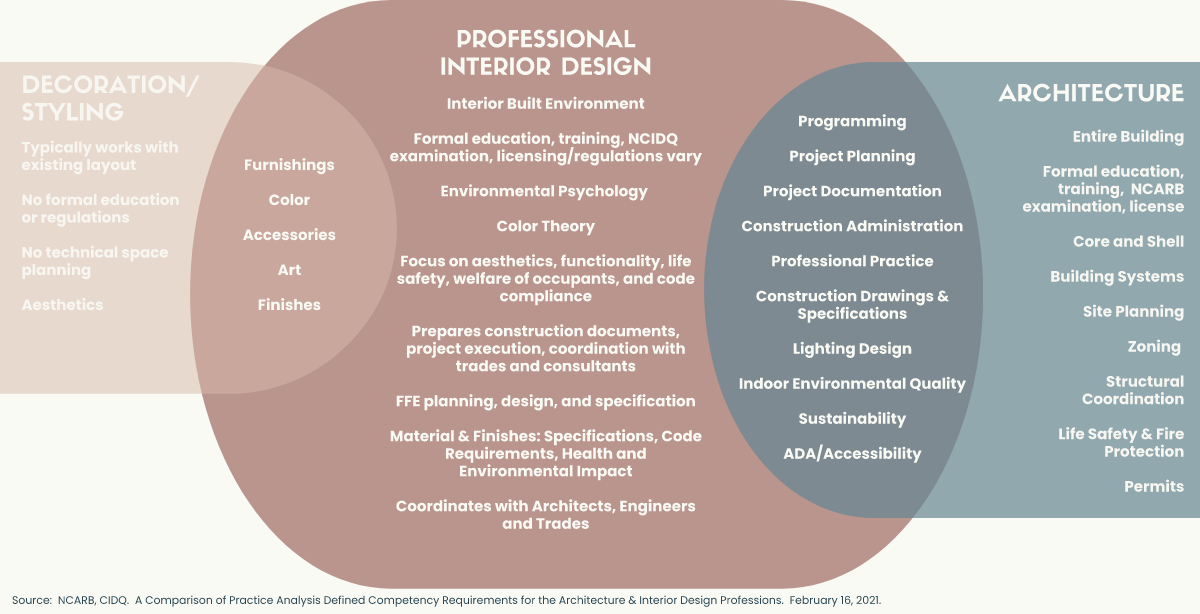
Architecture, interior design, and decorating overlap, but they are not interchangeable.
Architecture generally focuses on the building as a whole: structure, envelope, site, code framework, massing, core systems, and the broader built form. Interior design focuses on the interior built environment and on the experience, function, performance, and safety of the spaces people actually occupy. Decorating usually focuses on visual styling, furnishings, accessories, and surface-level aesthetics, often within an already established layout. Professional interior design includes programming, project planning, construction drawings and specifications, lighting design, indoor environmental quality, accessibility, sustainability, and coordination with trades and consultants, while decoration is typically aesthetic and works within an existing layout without the same technical scope.
That distinction is important. Decorating is valuable, but it is not the same as professional interior design. Interior designers are not simply selecting pretty things. We are shaping how a space functions, how it supports behavior, how it meets regulations, and how it feels to inhabit.
What professional interior designers actually do
Professional interior design starts long before finishes are selected. The earliest phase is often pre-design or programming, where the project is researched, framed, and defined. Designers gather facts, identify issues, understand users, define goals, assess building conditions, study codes, and translate all of that into a program that sets the direction for the project. This includes project scheduling, scope, budgeting, research, problem statement creation, site analysis, code analysis, as-built documentation, inventory, and coordination with consultants and regulatory bodies. This is not done in isolation. The entire project team, including the interior designer, is often involved in these early conversations and activities.
That foundation matters because good design does not start with style. It starts with understanding. When a designer is brought in too late, the impact is superficial. By integrating the process from the beginning, these crucial first steps ensure a more cohesive outcome.
The program document is the formalized gathering, organizing, analyzing, interpreting, and presenting of information relevant to a project, moving from analysis of the existing state toward a projection of what the future state should be. During the programming activities, facts are organized into issues, filtered through client values, translated into project goals and objectives, and eventually expressed through design concepts.
In practical terms, that means interior designers are asking questions such as: Who is using the space? What activities happen there? What equipment is required? What adjacencies are necessary? What are the circulation needs? What environmental conditions are needed? What safety concerns exist? How will the space adapt over time? Interior designers specifically analyze user requirements, activity requirements, square footage needs, circulation, access to daylight and views, building constraints, building systems interaction, accessibility, and adjacency relationships.
“Good design does not start with style. It starts with understanding.”
Space planning is not just fitting things into rooms
One of the most underestimated areas of interior design is space planning. To outsiders, it can look simple. It is not.
Space planning is the careful organization of rooms, zones, thresholds, circulation paths, furniture layouts, equipment clearances, and user relationships so a space functions well for the people who use it. Adjacency analysis addresses required person-to-person contacts, movement of objects and equipment, degrees of adjacency, functional zoning, and relationships to entrances, services, views, and other outside conditions. Bubble diagrams and block plans are used to test those relationships before they are formalized into floor plans.
A strong plan considers more than what fits. It considers what flows, what conflicts, what needs privacy, what needs visibility, what should feel open, and what should feel protected. It asks whether the circulation is intuitive, whether staff or service paths interfere with public experience, whether people can orient themselves, and whether the layout supports the intended use over time.
Interior design is deeply tied to human behavior
This is where interior design becomes much more than arrangement.
Professional interior design studies how environments influence human behavior, perception, wellbeing, comfort, and interaction. Professional interior designers study environmental psychology considerations such as sensory experience, Maslow’s hierarchy of needs, prospect and refuge, territoriality, privacy, personalization, and proxemics.
That means designers study how people feel in space, not just how space looks. We think about how lighting affects alertness or calm, how acoustics affect concentration and stress, how privacy or openness changes social behavior, how layout influences wayfinding, and how material and sensory cues shape memory, comfort, and belonging. This is especially relevant in public-facing environments where people may be arriving with different levels of familiarity, confidence, mobility, sensory tolerance, and emotional regulation.
When integrating design thinking tools like persona creation, journey mapping, and empathy-based design tactics, we translate research into usable insight. By asking who the users are, what they need, and about their experience, we design spaces that can better support them.
Anthropometrics, ergonomics, and inclusion are core to the work
Interior designers work with the human body as a baseline for design decisions. That includes an understanding of anthropometrics, ergonomics, reach ranges, body clearances, seating dimensions, surface heights, turning radii, accessibility requirements, and the broader principles of universal and inclusive design.
This is one reason the profession matters so much in complex spaces. Good design cannot assume one type of user. CIDA standards include human-centered design, ergonomics, inclusive design, and universal design as key expectations in professional education.
In practice, this means asking whether a space serves people of different ages, sizes, physical abilities, sensory needs, and communication preferences. It means understanding how a parent with a stroller, an older adult with low vision, a wheelchair user, a person with sensory sensitivity, or a first-time visitor navigates and experiences the same environment.
Materials and finishes are performance decisions
People often think materials are chosen primarily for aesthetics. In professional practice, that is only part of the equation.
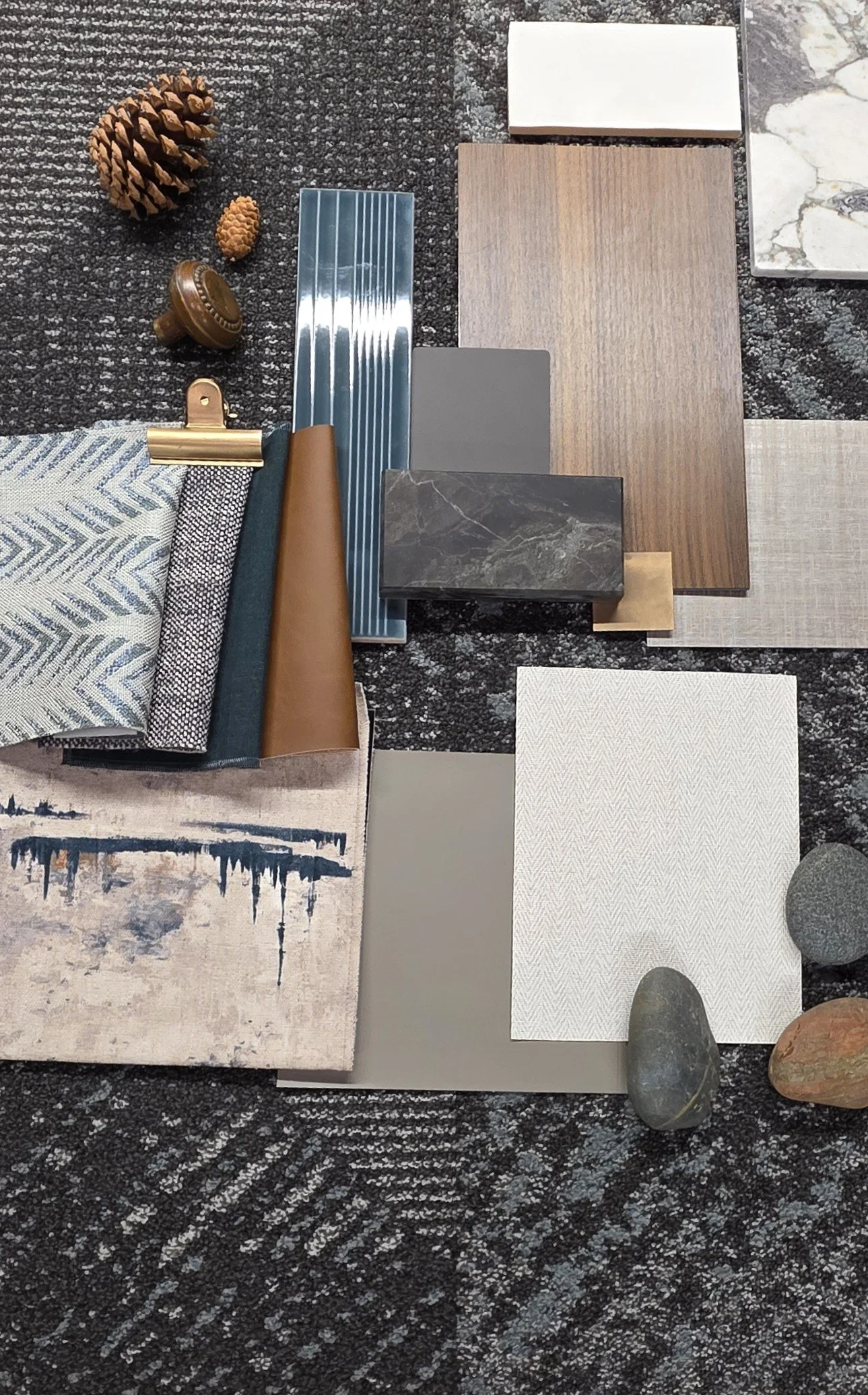
Interior designers evaluate materials and finishes based on durability, maintenance, lifecycle performance, environmental impact, safety, fire resistance, health considerations, installation conditions, and budget. Material and finish decisions relate to walls, floors, ceilings, furniture, millwork, lighting, hardware, accessories, and window treatments, while also accounting for substrate, installation, maintenance, and durability. The NCIDQ definition of interior design states that products and materials are selected based on code compliance, maintenance, lifecycle performance, sustainable and environmental attributes, and the needs of occupants and users.
In other words, the selection of flooring in a public lobby, upholstery in a waiting area, or millwork in a library or hospitality setting is never just about color. It is about wear, cleanability, acoustic absorption, slip resistance, fire and safety code requirements, indoor air quality, maintenance resources, and user comfort.
Lighting, acoustics, and comfort shape experience more than most people realize
Another overlooked area of the profession is environmental comfort.
Lighting design includes natural and electric illumination, light levels, color temperature, glare, reflection, diffusion, controls, task lighting, accent lighting, and how light interacts with color and material. Lighting is a major design feature, arguably one of the most important as lighting impacts how the space is perceived and navigated.
Acoustics matter just as much. Sound intensity, sound control, speech privacy, surface conditions, sound transmission, masking systems, and the geometry of space all affect whether a place feels calm, functional, distracting, or overwhelming. Building systems and acoustics are specifically identified as part of the designer’s coordination role.
These are not marginal concerns. They directly affect learning, healing, concentration, social comfort, rest, and behavior.
Wayfinding is part of interior design
Wayfinding is another area many people assume belongs to signage alone. It does not.
Professional interior design includes the ability to help people understand where they are, where they are going, and how to move confidently through space. Wayfinding is the ability to navigate through cues at decision points based on psychological patterns, visual perception, orientation, visibility, landmarks, configuration, material, finish, color, and lighting.
That is why interior design in public spaces is so consequential. A person should not need to decode a building to use it. The space itself should help them.
Interior design is also technical documentation and coordination
This is the part of the profession most invisible to the public and often the most time-intensive.
Interior designers move from research and concept into design development and construction documentation. Design Development is where the project is where all design decisions are made and the direction is set, including finalized space planning, furniture and finish selections, custom millwork, hardware, lighting integration, and visualizations. Then we shift into Construction Documentation to translate that intent into technical drawings, schedules, specifications, room data sheets, and bid-ready information to be integrated into the drawing set.
This documentation is what allows a project to be priced, permitted, coordinated, and built.
Designers also coordinate with architects, engineers, trades, vendors, and specialty consultants. This can include coordination with electrical, data, AV, security, mechanical systems, acoustics, water systems, and structure where interior work intersects with building systems.
That level of coordination is especially important in workplaces, libraries, healthcare settings, hospitality, civic spaces, multifamily, education, and adaptive reuse projects, where systems are layered and the margin for error is low.
The design process is structured for a reason
Professional interior design is not a free-floating creative exercise. Simply having good taste does not equate to good design. Design follows a phased process because complex projects require order, review, decision-making, and coordination.
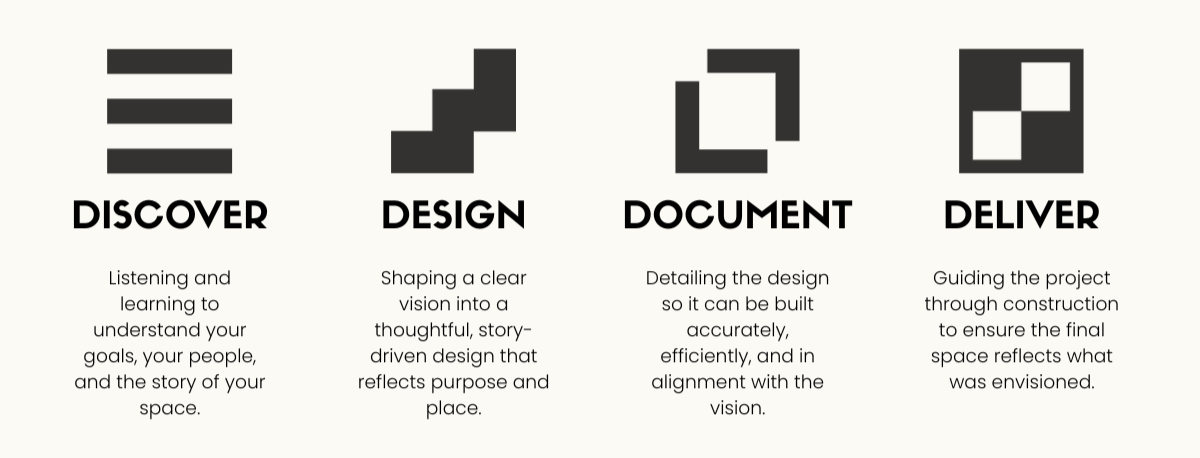
We have discussed our specific process at length in our January 2026 Insight Blog Post. While our process is broken down into 4 phases: Discover, Design, Document, and Deliver, most projects run through a similar process. First, during Discovery, Pre-design defines needs and constraints, Programming extracts research into spatial requirements, and a Conceptual project narrative sets the tone for the project. Moving into Design, first Schematic Design establishes direction through initial layouts, and broad planning before Design Development resolves the project in greater detail. As we shift into the Document phase, Construction Documentation turns it into a buildable set including drawings, specifications and schedules. Finally, in Deliver, Construction Administration activities and Furniture Administration or Procurement sees the project come to physical reality. Post-occupancy evaluation reviews performance after the space is in use to test for success or where improvements and modifications may be required. We use Post-occupancy user surveys, indoor air quality measurements, lifecycle assessment, benchmarking, and support for future renovation or expansion. That final phase is worth noting because it reflects something important about the discipline: the work is not only about producing drawings or images. It is about whether the built environment actually supports users.
Why accredited education matters
One of the persistent problems in public conversations about interior design is that people judge the profession by what they see on television, social media, or in casual residential styling. That is not the benchmark. We have a PR problem thanks to pop culture’s characterization of the field.
Accredited interior design education is built around measurable professional standards. The CIDA Professional Standards require students to develop competency in design process, communication, collaboration, history and theory, human-centered design, products and materials, environmental systems and wellbeing, building systems, construction, regulations, professional ethics, and business practices. Students in accredited programs do not simply learn how to make spaces attractive. They learn how to research, analyze, document, coordinate, communicate, and design responsibly. They learn how to solve problems, not just compose images.
That is why education matters, and why critiques of the profession often fall flat when they come from people who have never experienced the depth and breadth of an accredited curriculum. The majority of large AEC firms who design in the public domain prefer, if not require candidates to have an accredited degree.
“Students in accredited programs learn how to solve problems, not just compose images”
Why NCIDQ certification matters, especially in complex public spaces
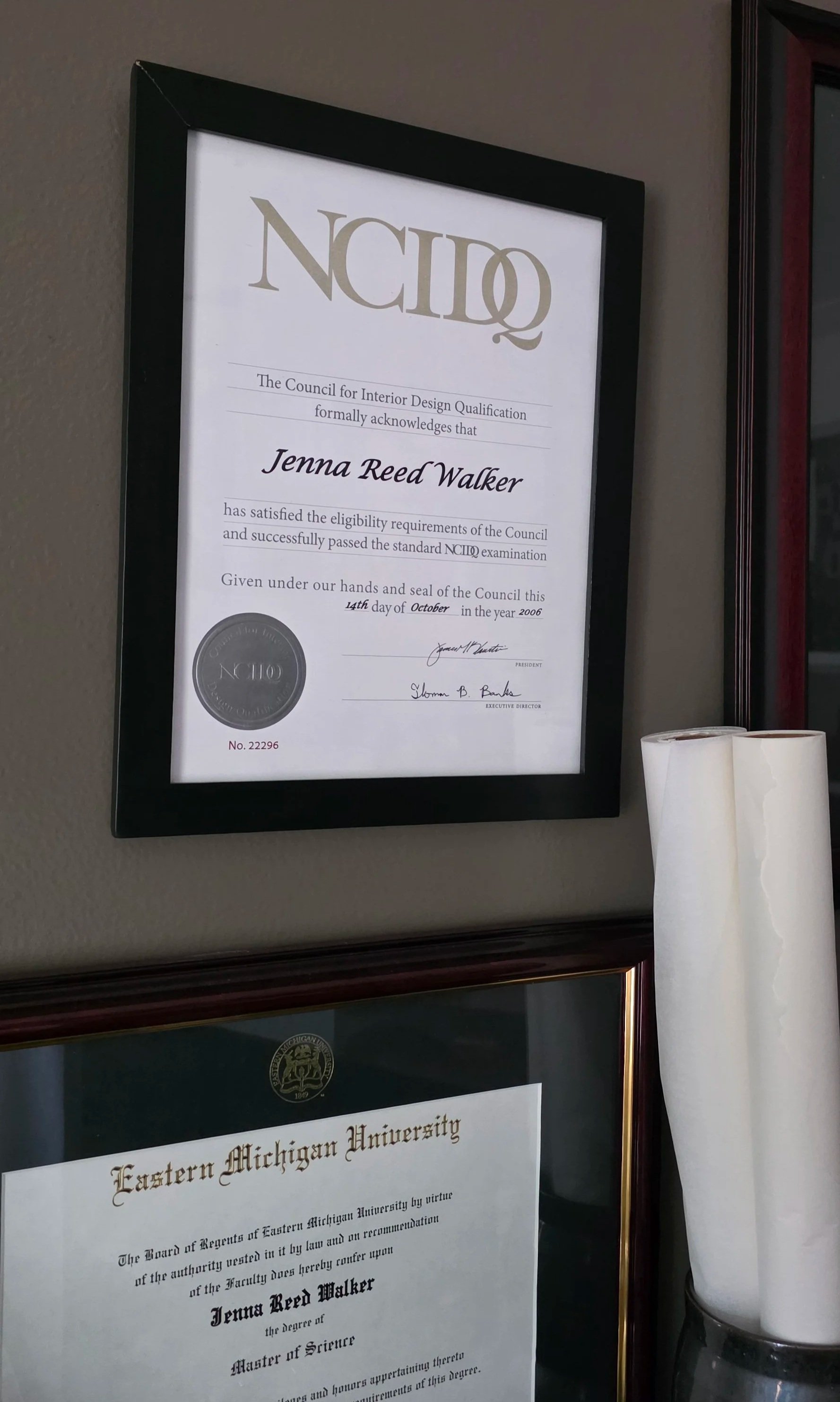
NCIDQ certification matters because it is one of the clearest indicators that a designer has met a recognized professional standard grounded in education, experience, and examination. The NCIDQ definition states that qualified interior designers are identified by education, experience, and examination and are responsible for protecting consumers and occupants through code-compliant, accessible, and inclusive interior environments.
That matters most in complex, public-facing, and regulated spaces.
In environments such as libraries, healthcare, hospitality, multifamily, workplace, education, civic, and community-centered projects, design decisions carry consequences. These spaces must address accessibility, occupancy, fire and life-safety requirements, means of egress, material performance, user diversity, circulation clarity, and coordination with multiple consultants and contractors. The CIDA standards explicitly include regulations and guidelines related to occupancy calculations, travel distance, means of egress, fire and smoke considerations, and accessibility requirements.
These are not conditions where design can be based on aesthetics alone.
NCIDQ certification signals that a designer has been tested on the knowledge necessary to work responsibly in these environments. It does not mean non-certified designers have no value. It does mean that when a project carries real public use, regulatory complexity, or health, safety, and welfare implications, certification is meaningful. It reflects a level of technical competence and professional accountability that should matter to clients, collaborators, and communities in the same manner as other licensed professionals like architects and engineers.
Interior design is a holistic profession
At its best, interior design is the careful synthesis of people, place, architecture, objects, systems, and meaning.
It involves research and imagination. It requires empathy and technical discipline. It addresses behavior, comfort, circulation, acoustics, lighting, materials, documentation, code, accessibility, and long-term performance. It asks not just what a space looks like, but how it works, how it feels, what it communicates, and who it truly serves. It does not care if the space is new or if it is an existing space being transformed to support a new experience.
That is why interior design cannot be reduced to decorating, and why it should not be treated as secondary to architecture. It is a distinct professional discipline that evolved in the early 1900s alongside new and expanding public life. It focuses on the lived experience of the built environment.
At Reed Walker Design Collective, that is how we approach every project. We are not simply selecting finishes or arranging furniture. We are shaping the spaces where people gather, work, learn, heal, stay, and belong.
Tell us about your project
If you are planning a renovation, adaptive reuse, hospitality project, workplace, library, community space, or home and want to think more deeply about how the space should function and feel, this is exactly where professional interior design adds value.
Ready to get started? Tell us about your project.
