
insight: our DISCOVER phase
Programming and Concept Development as The Strategic Foundation of Interior Design
Most people imagine interior design beginning with a mood board. Something visual, something beautiful, something that captures the feeling of the finished space before a single wall is touched.

Residential mood board and design narrative for a private residential client, courtesy of Reed Walker Design Collective, 2025
That is a reasonable assumption. It is also where most projects start to go sideways.
At Reed Walker Design Collective, our process begins somewhere different: with a conversation, with questions, with listening. Before we sketch anything, we need to understand who you are, what this space needs to do, and what story it should carry. That is not preamble to the real work. That is the work. Don’t worry, we will still get to the mood board.
“Before we sketch anything, we need to understand who you are, what this space needs to do, and what story it should carry.”
This month's Insight explores Reed Walker Design Collective’s DISCOVER Phase, where programming and concept development set the strategic foundation for the project. This happens before drawings, before material selections, before any of the visual decisions that come to define a project. If you have read our previous posts on storytelling (December 2025) and the power of process (January 2026), this post picks up where those left off. If you are arriving here fresh, welcome. This is a good place to start, as it is a deep dive into the first of the four project phases all of our design projects go through: DISCOVER, DESIGN, DOCUMENT, DELIVER.
the design project Before Drawing
Here is something worth sitting with: design consists of thousands of decisions, big and small. The earliest ones carry the most weight.
When the process begins with sketches instead of strategy, those early decisions are made without adequate information. The layout is proposed before anyone truly understands who uses the space, how they move through it, and what they need from it. Materials are selected for aesthetics before anyone has asked whether they will hold up to the actual conditions of the space. Concepts emerge from a designer's imagination rather than from the specific context, culture, and community that the project serves.
This is not an indictment of creative instinct. Creative instinct is essential. But instinct without information produces spaces that look good in photographs and feel hollow in person.
Listening before sketching is not a personality preference. It is a professional discipline. The most cohesive, meaningful, durable interiors we have worked on share a common thread: someone invested in understanding deeply before proposing solutions.
That investment is programming. And when it is done well, it transforms concept development from a creative exercise into a genuine design strategy.
“Instinct without information produces spaces that look good in photographs but feel hollow.”
What THE DISCOVER PHASE Actually Includes
During our Discover Phase, we conduct initial research and analysis to develop a comprehensive understanding of the project, including its context, constraints, goals, schedule, and budget. This is often called programming. Programming is the analytical, research-intensive phase that precedes design direction. It is where we gather, organize, and interpret the information that will eventually guide every spatial and material decision in the project.
In practice, our Collective Co-Design Discover Phase includes several distinct but interconnected activities.

Stakeholder interviews are often the first and most essential input. We talk with the people who will use the space, the people who operate it, and the people who have invested in it. These conversations are not casual. We are listening for patterns, tensions, and shared priorities. We are asking about identity, memory, aspiration, and daily rhythm. For a community institution, that might mean conversations with patrons across age groups, staff members in different roles, and community leaders who understand the organization's place in the broader civic landscape. For a hospitality project, it means understanding what kind of experience the owner wants to offer, what their guests are seeking, and how the space will need to function across different times of day and seasons.
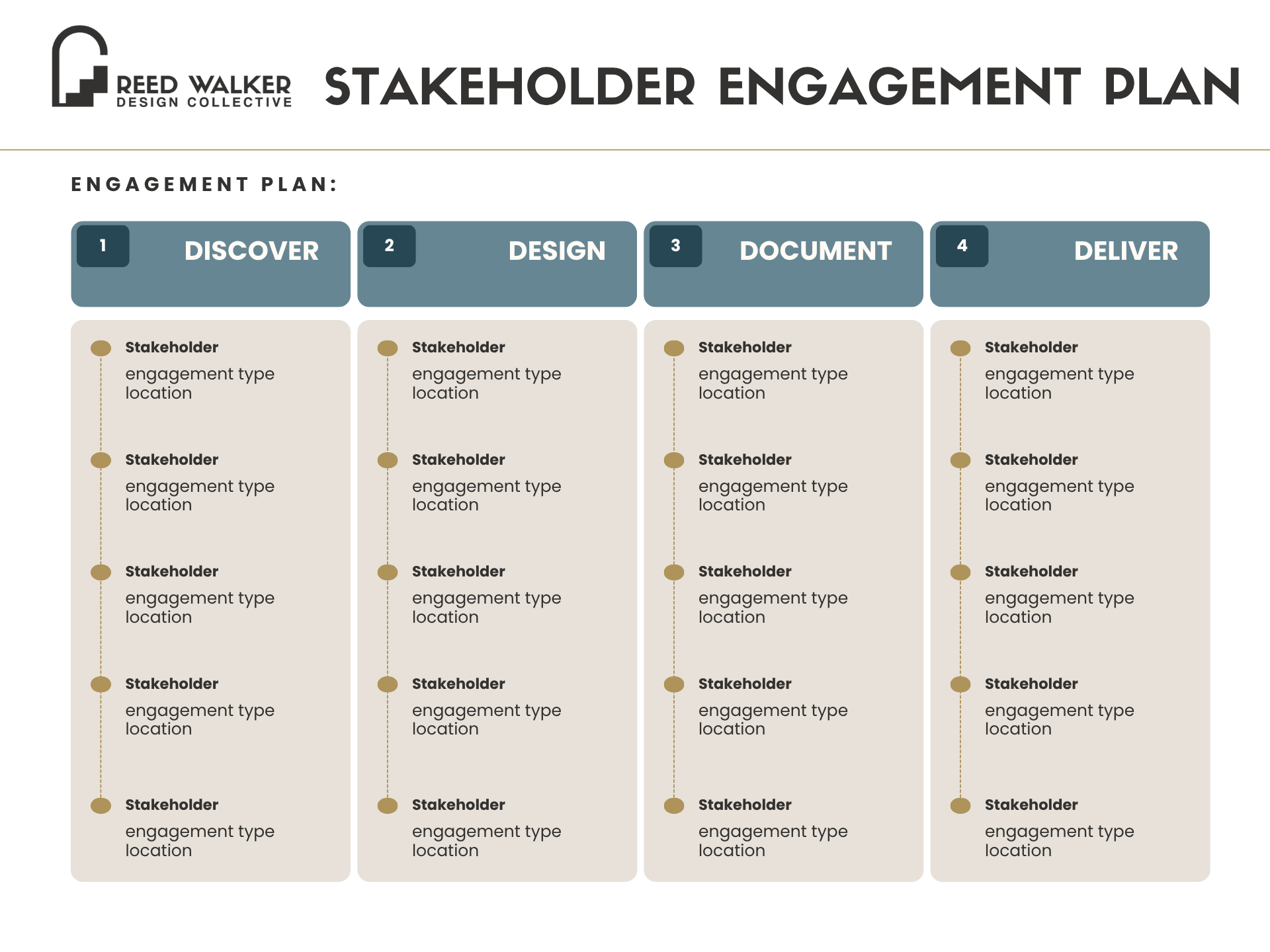
RWDC integrates stakeholder engagement throughout the Collective Co-Design process
Operational mapping translates those conversations into spatial logic. How do people move through this space? Where do workflows intersect, and where do they need to be separated? What adjacencies support efficiency, and what adjacencies create friction? What happens at 9 a.m. on a Tuesday versus a Saturday evening? Good programming accounts for the full life of a space, not just its ideal conditions.
Adjacency analysis is where programming starts to look more like the first rough language of a floor plan. Which spaces need to be close to each other, and which need distance? Where is visual connection valuable, and where does privacy matter? These questions shape spatial planning before a single room is drawn.
Budget alignment is part of programming, not a constraint added later. Understanding what a project can reasonably achieve, where investment is best concentrated, and where phasing might allow scope to unfold over time is critical information. Design decisions made without budget context create proposals that cannot be executed, which erodes trust and wastes time.
For historic buildings, preservation overlays become an added dimension of discovery. This means analyzing the building's significance, understanding what features are character-defining, and mapping the requirements of the Secretary of the Interior's Standards for Rehabilitation from the very beginning of the process. We have written about this at length in our March 2026 Insight on historic preservation. The short version is this: when preservation requirements are introduced late, they force redesign and compress timelines. When they are integrated into programming, they shape narrative and scope from the start, which is where they belong.
Concept as Narrative
Concept development is where everything gathered in programming is synthesized into a clear, guiding idea for the project.
We have talked about why story is the structural foundation of our process. Concept is where that story gets named. It is the distilled answer to the question: what is this place, and what does it mean to the people it serves?
“Concept is where that story gets named. It is the distilled answer to the question: what is this place, and what does it mean to the people it serves?”
Place-based storytelling is central to how we develop concept. For a historic downtown building being converted to a boutique hotel, the concept is not simply "warm and rustic." It is grounded in the specific history of that building, that town, and those materials. The original masonry cladding. The architectural details that survived decades of changing uses. The stories that locals tell about what this building has meant to their community over generations. The concept names and honors all of that, then asks: what does this building want to be next?
Brand immersion matters for community, commercial and hospitality clients in particular. The concept must align with how the owner understands their own identity and how they want their guests or clients to feel from the moment they arrive. A boutique dental practice serving a professional clientele in a suburban community has a very different emotional brief than a community health clinic designed to welcome patients who may arrive with anxiety or distrust of medical settings. Both deserve concept development that is specific to who they are.
Emotional outcomes are the clearest measure of whether a concept is working. At the end of programming and concept development, we should be able to answer clearly: what should someone feel the moment they cross the threshold? What memory should they carry with them when they leave? What should this space communicate about the people who built it and the community it serves? These are not soft questions. They are the design criteria that make everything else legible.
When concept is grounded this way, it becomes a decision-making compass for the entire project. Every material selection, every spatial gesture, every lighting choice can be evaluated against it. Does this serve the concept, or does it undermine it? That filter prevents design drift, reduces decision fatigue, and keeps the entire project team aligned through the long, complex months between first sketch and final installation.
Where This Shows Up in Practice
The value of programming and concept development in the DISCOVER Phase is most visible in the project types where stakes are highest and context is most complex.
In boutique hospitality, every detail is an experience decision. Guests are paying not just for a room but for a feeling, a story, a reason to return. When programming has done its job, the concept is specific enough to guide decisions at every scale, from the proportions of the check-in area to the texture of the bath linens. Without it, hospitality interiors become a collection of aesthetically pleasing choices that add up to something generic, forgettable, and ultimately uncompetitive in a market where guests can compare options endlessly before booking.
In civic and community spaces, programming is particularly critical because the user base is so diverse. When we work on projects serving multigenerational, multicultural communities, the needs are shifting and layered. An aging population, growing cultural diversity, and changing expectations for how public spaces function as community gathering places: none of that can be addressed through aesthetic instinct alone. Programming surfaces the real design criteria, which then shapes a concept grounded in the institution's heritage, a commitment to inclusion, and a clear-eyed understanding of its evolving role as a civic anchor.
In adaptive reuse and historic rehabilitation, concept development is inseparable from preservation strategy. The building itself is a co-author. Its material logic, structural rhythm, original craftsmanship, and layered history all inform what the next chapter of the space should look and feel like. When we work on a historic commercial building being reimagined for a new use, the concept cannot be invented from scratch. It has to be earned through research, through understanding what the building has meant to its community, and through careful alignment with the preservation standards that govern what changes are appropriate. Programming makes that possible.
The Cost of Skipping Strategy
We are occasionally brought into projects mid-stream, when the architect has already programmed the building, layouts are set, or construction could already be underway.
These projects share recognizable patterns. There is no clear direction, or there are multiple competing visions that were never reconciled. Decisions were made under pressure, driven by preference rather than purpose. Aesthetic ideas accumulate without a connecting thread. The owner feels uncertain, the contractor feels frustrated, and the design team is spending energy on course correction rather than refinement.
Scope creep, which is one of the most common and costly problems in design and construction, is frequently a programming failure. When the full scope of a project is not understood early, additions and changes accumulate throughout the process. Each individual decision may feel small. Collectively, they drive cost overruns, schedule delays, and outcomes that do not match the original vision.
Rework is a related pattern. When design direction is established before the right questions have been asked, changes become inevitable. A floor plan that seemed logical in the abstract does not work operationally. A material that was selected for aesthetics fails to meet the performance requirements of the actual use. A concept that was developed without stakeholder input does not resonate with the community it was supposed to serve. Lighting that was laid out in a simplistic grid without consideration of experience or activity falls flat. Each of these scenarios means going back, which costs time, money, and trust.
Misalignment, between owner and designer, between design team and contractor, between the project's intent and its execution, is the most damaging outcome. It produces spaces that feel hollow because they were never grounded in a shared understanding of purpose.
The antidote to all of this is not more revisions. It is better discovery.
How This Connects to Our Process
Everything described in this post is embedded in the Discover of our Collective Co-Design process. Our process is not four sequential steps. It is an integrated framework where alignment precedes aesthetics, where stakeholders are partners, and where preservation, strategy, and narrative are woven throughout rather than added later.

Programming is the mechanism that makes Discover meaningful. Concept development is what transforms the insights from Discover into an actionable direction for Design. Together, they are the strategic foundation that every downstream decision rests on.
This is also one of the clearest differences between our approach and a traditional AEC model. Traditional design often begins with a program handed to a designer and a deadline by which drawings are expected. The process is linear, the feedback loops are limited, and alignment is assumed rather than built.
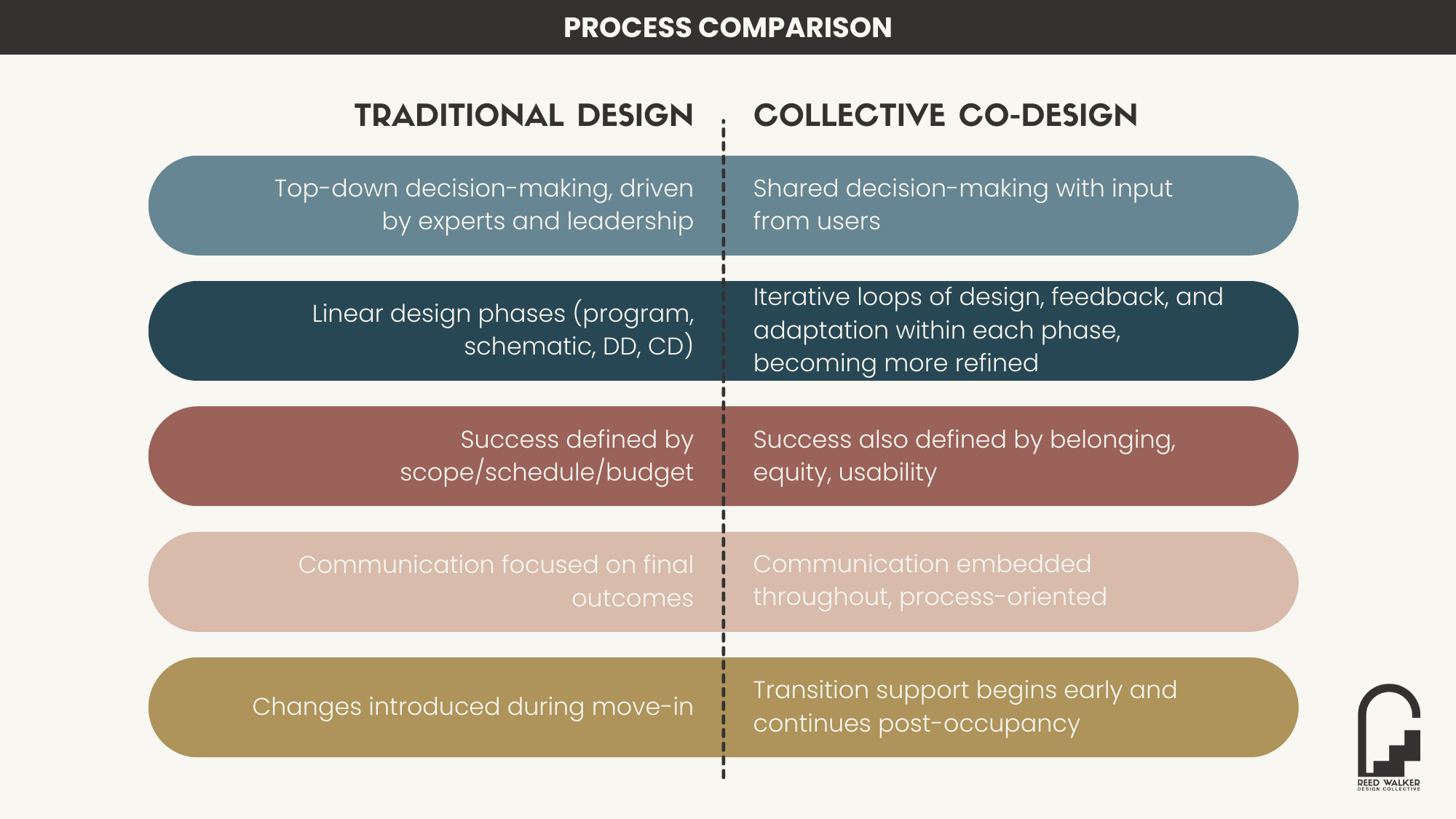
Collective Co-Design begins with listening. It builds alignment before it builds anything else. And when it works as intended, which it does when clients are willing to invest in the process, the result is a space that feels coherent, meaningful, and genuinely made for the people it serves.
Ready to Begin with Strategy?
If you are planning a renovation, historic rehabilitation, adaptive reuse, community space, or hospitality project, the most important question to answer early is not "what should it look like?" It is "what does this place need to be?"
We would love to help you find that answer. Start with our Project Inquiry Form, or reach out to schedule a Discovery Call. If you are earlier in the process and want a focused, low-investment entry point, our First Look consultation and Onsite Insight are designed exactly for this moment.
Strategy first. Story always. That is where it begins.
