
insight: change
The Hardest Part of a Renovation Isn’t Usually the Building
The space is finished. The lighting is right, the acoustics work, the layout does what everyone said they wanted it to do. And two weeks after opening, the staff are still walking the long way around to the desk they used to use. Someone has quietly moved a chair back to where it was before. A regular comes in, stands in the entry a second longer than usual, and uncertain where to go.
We have watched some version of this happen enough times to know it is not a failure of the design. It is what happens when a building changes faster than the people in it were prepared for.
And it is not a move-in problem. By the time the boxes are unpacked, the outcome has already been largely decided by what happened over the previous one to two years, from the moment the project came to inception, through the design process and into construction. The renovation was never only about the building. It was about a group of people who have to work, gather, serve, and be served inside it, and who are living through every phase of it.
Change Management… Change Leadership
Change Management is a real discipline with real methodology behind it, and we integrate it into our design process. We trained through Prosci nearly ten years ago and have carried that thinking into every project since. It gives us structure for the parts of a project that are easy to bypass: who is affected, how drastic, in what way, and what has to happen before they can adopt something new.
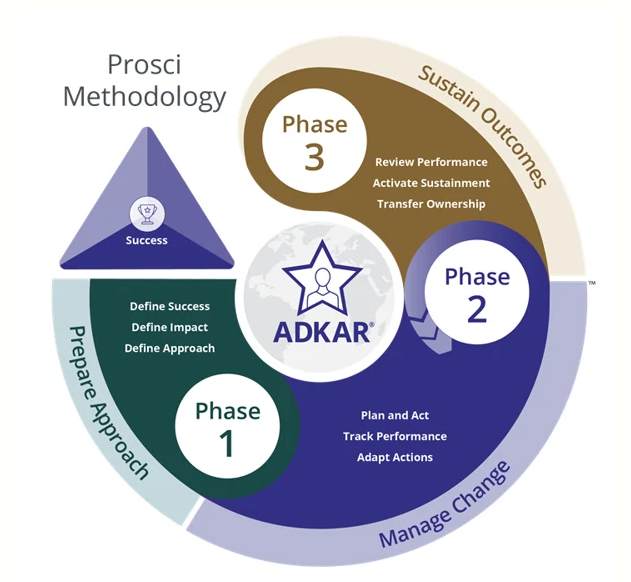
(C) Prosci | The Global Leader in Change Management
The word we use with clients, though, is Change Leadership. Management suggests a process that gets administered, a set of people who get moved through it. Leadership means someone, often more than one person, steps up and champions the change. They stand in front of a staff meeting and share what is changing, what is not yet decided, and what will be hard. They listen and adapt. They try to mitigate concerns, disruptions, and blatant resistance. And that someone is still there months later, when the enthusiasm has worn off and the dust barrier is still up.
The methodology tells us what to pay attention to during times of change. Change Leadership is who carries it.
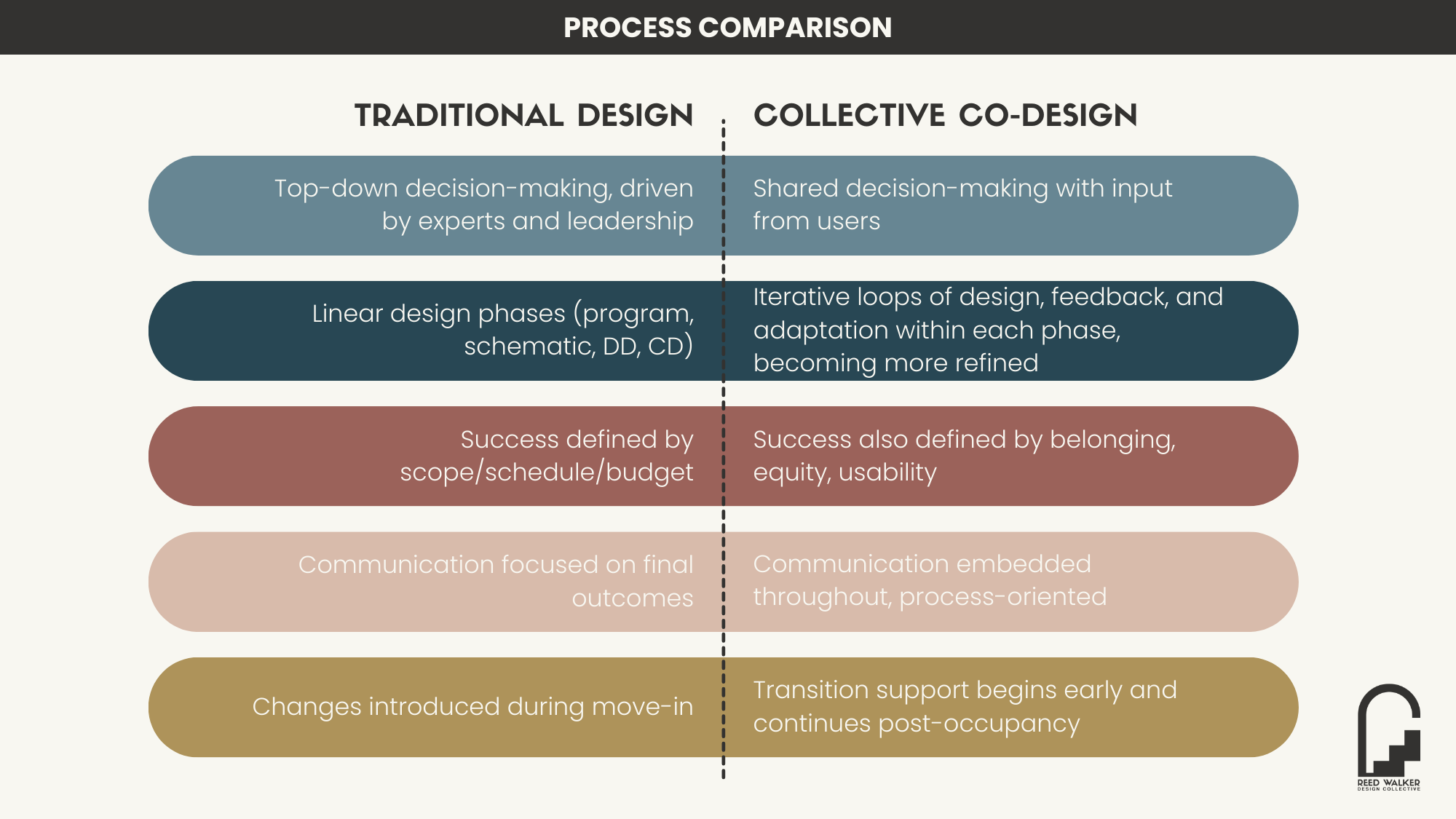
Resistance is information
The most useful thing we can say about resistance is that it is almost never about the actual change itself.
A staff group pushes back on a shared service desk. Underneath it: two departments answer very different kinds of questions, and one of them involves concentration that a busy counter with continuous disruption destroys. The objection was not about the desk. It was about a work condition the plan had not considered.
A volunteer group gets openly frustrated about a table being relocated. Underneath it: that table was where donations got sorted every Tuesday, a workflow that existed for twenty years but wasn’t mentioned during stakeholder meetings.
Someone in a public meeting says they do not want the seating by the window changed. Underneath it: that is the only place in the building with daylight and a view, and they have been coming there twice a week since their spouse died.
None of these people were being difficult. Each of them was holding information that had not made it into the room. When we treat that as a people problem, we lose the information and we make an adversary. When we treat it as a design signal, we get a better project.
Resistance also shows up on a schedule. It is highest at the start, when nobody knows what is coming, then again at the point where drawings become real and someone realizes their area is actually moving, then again about halfway through construction when the disruption has stopped being novel. Knowing that is most of the work. A team that expects those three moments can prepare for them. A team that gets surprised by them spends the project reacting.
Change leadership by phase
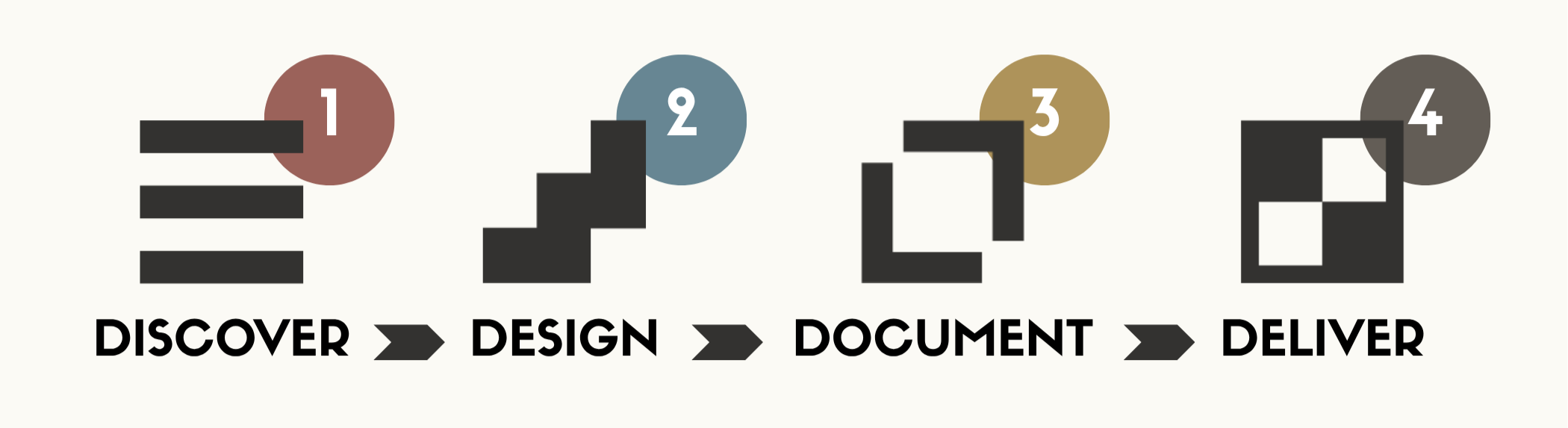
This is why the work is distributed across our four-phase process rather than concentrated at the end.
DISCOVER. This is where the impact assessment happens: who is affected, how deeply, and in what way. Staff, users, board or council, volunteers, partner organizations, the subgroups who are easy to leave off a list. It is also where we ask about the organization's history with change, because that history is usually the strongest predictor of how this project will go. A group that came through a rough renovation fifteen years ago is starting from a different place than one that has never done this before, and the plan should say so. Focus groups, listening sessions, and open comment tools run here, and they are built so people who cannot attend an evening meeting still have a way to share their voice.
DESIGN. The pivot point. Ideas stop being abstract and start having consequences for specific people, and this is where the second wave of resistance arrives. It is also the best window for real participation, because the plan is still forming. Design workshops, an open house, a furniture vote, a board presentation. And a working loop back to everyone who gave input in DISCOVER, showing where their input landed. If an idea was used, say where. If it was not, say why.
DOCUMENT. Quieter externally, and that quiet is the risk. Momentum dies here if nobody tends it, and a silence of several months reads to staff and community as a project that stalled. Steady updates, a clear picture of what is coming and when, and messaging built ahead of construction phasing rather than after it. The goal is at least several months of notice before any major disruption, so people can plan around it instead of absorbing it.
DELIVER. The longest and hardest stretch. Staff become the public face of a project they did not design, fielding the same questions daily while their own routines are disrupted. That deserves support: talking points, an easy way to escalate problems, and someone checking in rather than waiting for complaints. Milestones get marked, so the project reads as progress and not as a long inconvenience. Training happens before occupancy, not after, so people walk into the new space already knowing how it works and how to guide someone else through it. Then a post-occupancy evaluation at ninety days, which is when you finally learn what the space is actually doing and the last moment a correction is still cheap.
What gets lost when nobody names it
There is a part of this that most project teams skip, and it determines how the transition actually goes.
People lose things in a renovation. The corner someone always sat in. The counter they knew by feel, so well they could work it without looking. The room where a memory happened, a wedding reception, a first job, a meeting that changed something. Staff lose competence, temporarily, which is its own kind of loss. People who have done a job well for fifteen years suddenly cannot find anything, and they feel it.
Civic and faith organizations carry this heavily, because their buildings hold community memory in a way a lease does not. Small business teams carry it more quietly. Nobody wants to be the person who says they miss the old break room because they don’t want to seem ungrateful for what the renovation or new spaces brings.
The loss is going to happen whether or not anyone names it. The difference is what it turns into. Named out loud, acknowledged by someone with authority, it becomes something people can move through. Unnamed, it hardens into resentment that outlasts the construction by months or even years. We have sat in rooms where staff were still talking about a renovation from eighteen years ago, and what they described was never the design. It was that nobody told them what was happening or asked what it would cost them.
Four moves that carry the weight
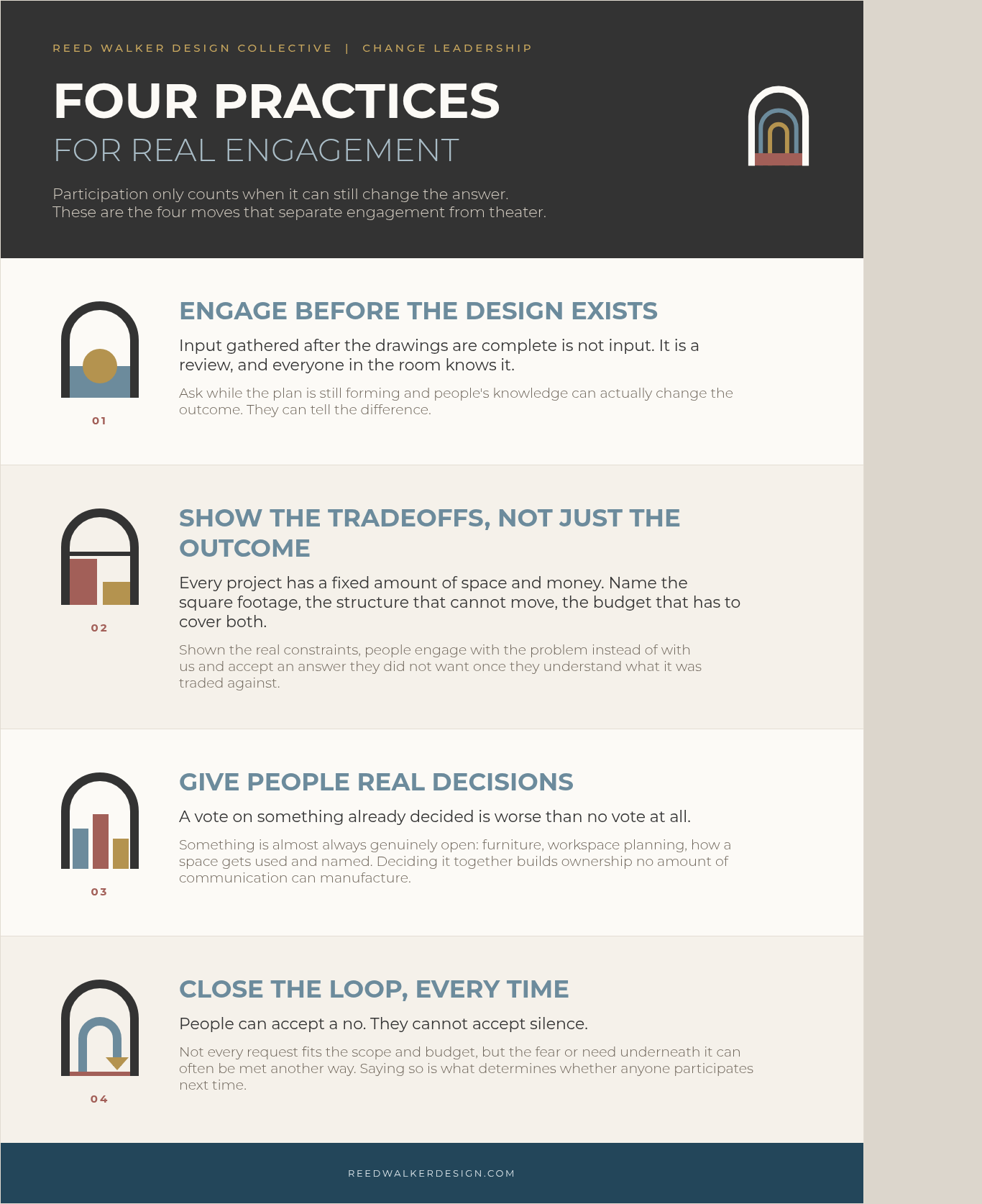
When a project needs more structure
Our co-design process supports teams through change by design. For many projects, that is enough.
Some projects need more. A large staff or service population. A long construction window with phased occupancy, where people are working inside the project rather than returning to it. An organization with a difficult history around change. A board or council that will be answering to the public. In those cases we build the structure directly and run it alongside the design work: an impact and readiness assessment in DISCOVER, a communication plan tied to the construction schedule, monthly coordination with internal project leadership so the team stays ahead of concerns rather than reacting to them, staff training sessions before occupancy, milestone planning through construction, opening and ribbon-cutting support, and the ninety-day post occupancy evaluation at the end.
It is one continuous thread, not a service bolted on at move-in. Which is also why it costs less to do than most organizations expect. The expensive version is the one where you start at the end and have to retroactively repair.
What it costs to skip it
The consequences are ordinary, which is what makes them easy to miss.
Rooms that sit empty because nobody was ever told what they were for. Staff turnover in the year after occupancy, from people who could have adapted with support and did not get any. A board that will not fund the second phase because the first one felt chaotic. Users who came less often during construction and never quite came back. A furniture package rearranged into something closer to the old layout within six months.
Every one of those is a loss on the investment. The construction cost is the same either way. The difference is whether the organization gets the return.
This is the same logic behind staying present through construction and installation. The last phase of a project is where the value either lands or leaks, and both the building and the people need someone paying attention while it does.
The second arrival
Go back to that opening scene. Same finished space, same lighting, same layout.
Different version: the staff have already walked the space and been trained on how it functions. They know where things are. They have practiced the new workflow. They know how to answer the question they are about to be asked forty times this week. The regular who lost the window seat knew months ago that it was coming, knew it was a real tradeoff, and knew what was gained. Someone stood up two years ago and said what was changing and what would be hard, and then stayed for all of it.
The building is identical. The experience of walking into it is not.
Belonging is not something a floor plan produces on its own. It comes from people understanding that a place was changed with them in mind, and being told so, all the way through, by someone willing to stand behind it.
If your organization has a renovation ahead and you know the people side is going to be the harder part, an Onsite Insight day is a direct way to start. One day on site, with your team, working through what is changing and what it will ask of the people who use the space.
If you are earlier than that, our guide Design with Everyone in Mind covers co-design, stakeholder engagement, and change leadership in more depth. It is free to download.
